
Views: 0
Great Hornbill: The Remarkable Bird of Asian Rainforests

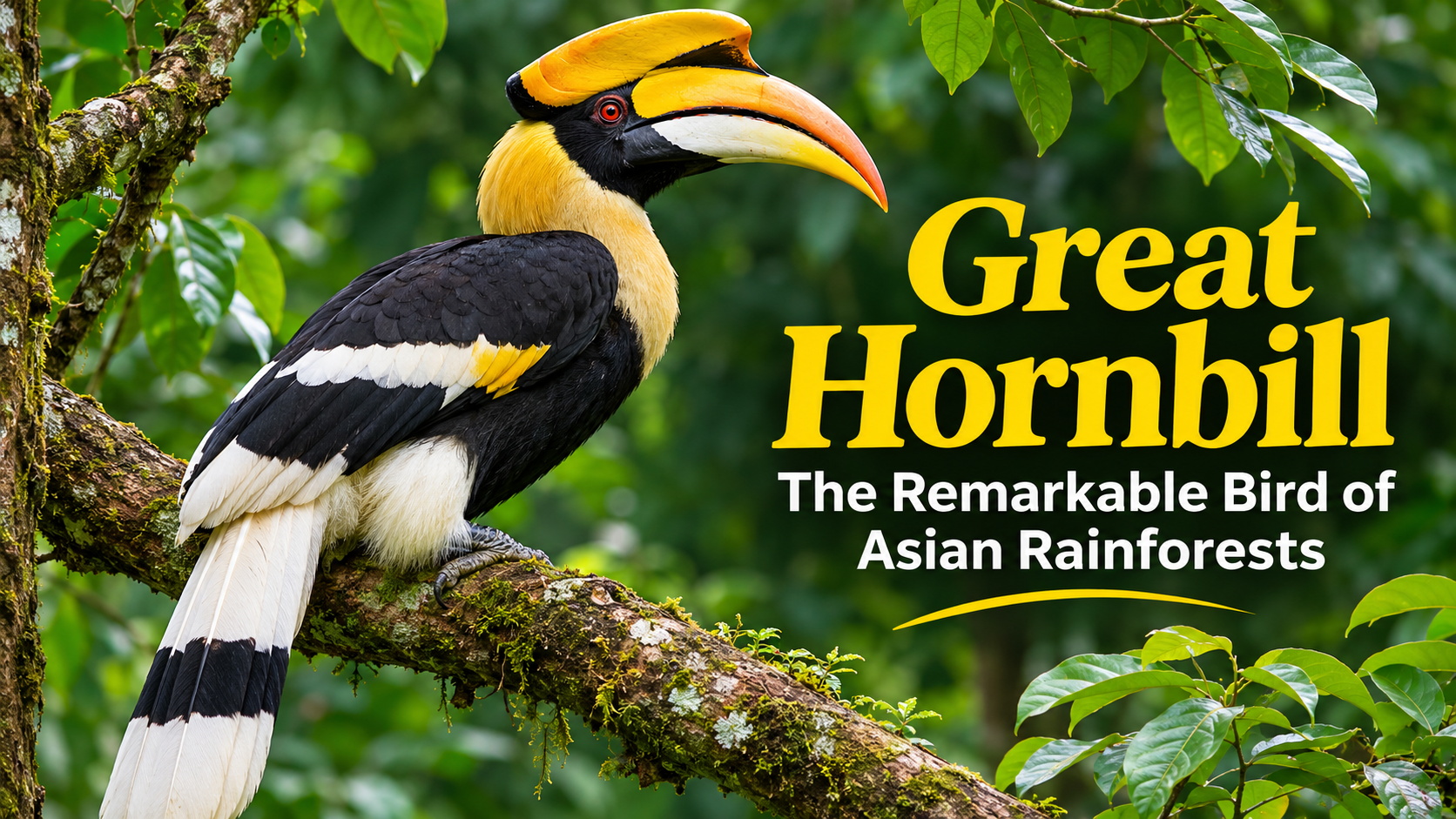
Deep within the tropical forests of South and Southeast Asia lives one of the world’s most extraordinary birds: the Great Hornbill (Buceros bicornis). With its enormous curved bill, prominent yellow casque, black-and-white feathers, and powerful flight, this bird is an unforgettable symbol of Asian rainforest wildlife.
Also called the Great Indian Hornbill, this species plays an important ecological role by dispersing seeds from the fruits it eats. Its remarkable nesting behavior and dependence on mature forests make it both fascinating and important to conserve.
Great Hornbill Quick Facts
- Scientific name: Buceros bicornis
- Family: Bucerotidae
- Length: Approximately 112–150 cm
- Habitat: Tropical evergreen and moist deciduous forests
- Distribution: South and Southeast Asia
- Diet: Primarily fruits, especially figs, plus small animals
- Conservation status: Vulnerable (IUCN)
Distinctive Appearance and the Enormous Casque
The Great Hornbill is among the largest members of the hornbill family. Its most recognizable feature is the large yellow bill topped by a prominent hollow structure called a casque. The exact functions of the casque remain an area of scientific interest.
Its broad black wings carry striking white markings, while the white tail is crossed by a broad black band. Pale feathers on the neck and other body areas may become golden-yellow from pigmented preening oils.
Male Great Hornbills generally have reddish eyes, while females have pale eyes and smaller casques, making it possible to distinguish adults of the two sexes.
Where Great Hornbills Live
Great Hornbills inhabit forests in southwestern India and along the southern Himalayan region, extending through parts of mainland Southeast Asia to Peninsular Malaysia and Sumatra. They favor areas with large fruiting trees and suitable nesting cavities.
These birds spend much of their lives in forest canopies, moving between trees in search of food. Their heavy wingbeats create a distinctive whooshing sound, and their loud calls can travel considerable distances through the forest.

Diet: Fruit Eater and Forest Seed Disperser
Fruit makes up the majority of the Great Hornbill’s diet. Figs are particularly important, but the bird also eats numerous other forest fruits, as well as insects, small reptiles, birds, and mammals.
As Great Hornbills move between fruiting trees, they transport and disperse seeds into different parts of the forest. This makes them important agents of forest regeneration, especially for some large-seeded tree species.

The Extraordinary Nesting Strategy
Great Hornbills have one of the most unusual breeding strategies among birds. During nesting, the female enters a cavity in a large tree and seals most of the opening with nesting material, leaving only a narrow gap.
Through this gap, the male delivers food to the female and later the developing chick. The arrangement offers protection from some threats, but also makes the breeding family strongly dependent on the male’s ability to gather food.
Because breeding requires suitable cavities in large, mature trees, removing old forest trees can seriously affect reproductive success. Protecting nesting trees is therefore a vital conservation priority.

Why Great Hornbills Matter to Rainforests
Great Hornbills are important links in tropical forest ecosystems. By feeding on many kinds of fruit and transporting their seeds, they help maintain plant diversity and contribute to forest regeneration.
They also depend on extensive, connected forest habitats containing mature trees. Their conservation can therefore benefit other birds, mammals, plants, and insects that share the same environment.
Conservation Status and Major Threats
The Great Hornbill is classified as Vulnerable on the IUCN Red List. The 2020 global assessment estimated 13,000–27,000 mature individuals and identified a decreasing population trend.
Major threats include deforestation, habitat fragmentation, loss of nesting trees, and hunting. Forest protection, community-based monitoring, and the preservation of large nesting trees are important for the species’ future.
Conclusion
The Great Hornbill is far more than a spectacular rainforest bird. Its enormous casque, powerful flight, unusual nesting behavior, and seed-dispersal role make it one of Asia’s most remarkable forest inhabitants.
Protecting this species means preserving the mature trees, fruiting forests, and connected habitats on which countless other forms of wildlife also depend.
Sources and Further Reading
Photo credits and licenses: Shino jacob koottanad, CC BY-SA 4.0; Drsssuresh1961, CC0 1.0; Lip Kee, CC BY-SA 2.0; Rohit Naniwadekar, CC BY-SA 4.0. Original photographs shown without alterations.