
Views: 0
European Bee-Eater: Colors, Migration and Hunting
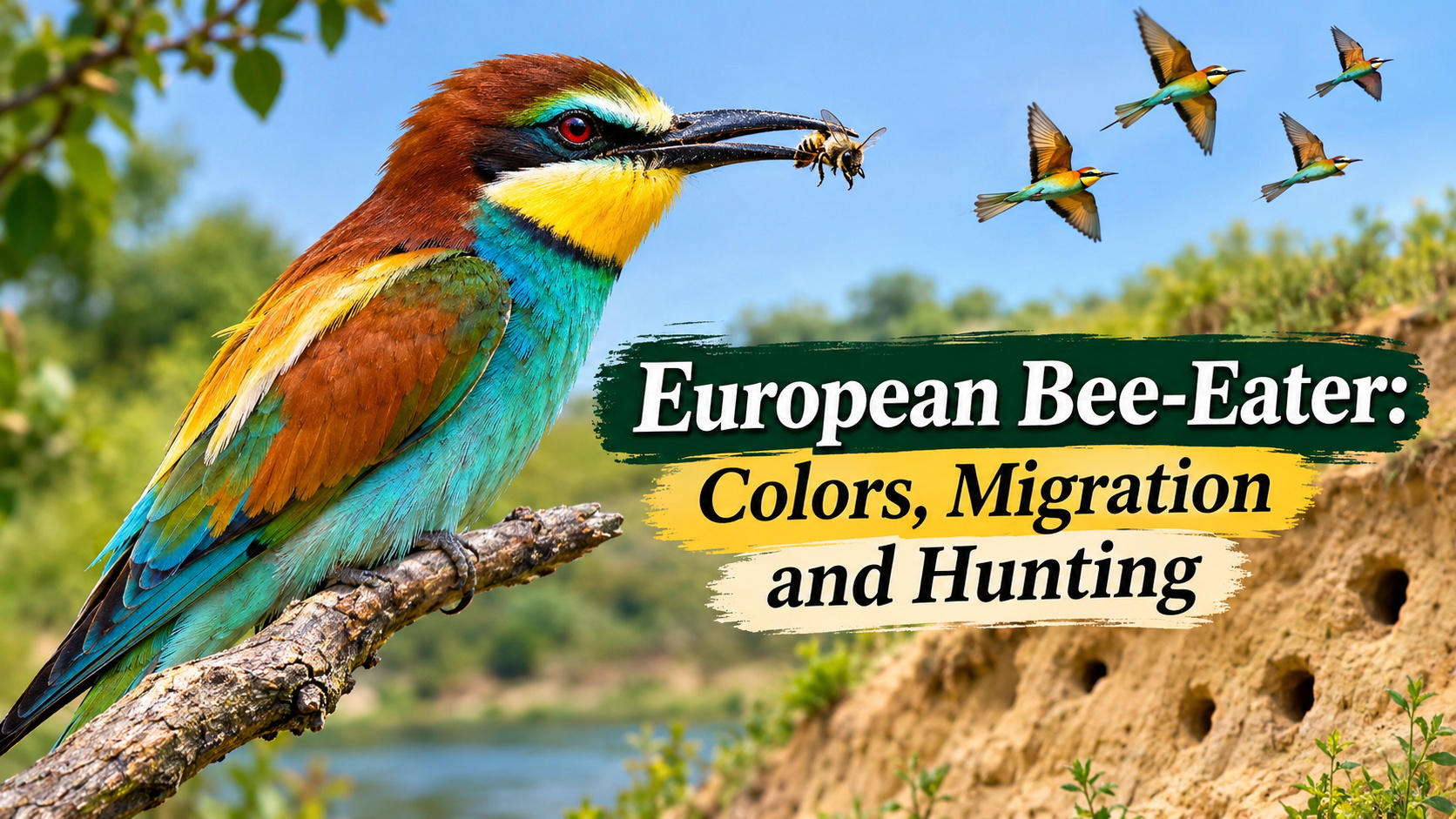
The European Bee-eater (Merops apiaster) is one of the most spectacular birds of Europe, Africa, and western Asia. Its brilliant turquoise-blue body, golden-yellow throat, chestnut-colored back, and striking black eye stripe give it an almost tropical appearance.
Beyond its colorful feathers, this fascinating bird is known for its extraordinary aerial hunting abilities, long-distance migrations, and unique nesting habits. From catching flying insects to traveling thousands of kilometers between continents, the European Bee-eater is a remarkable example of adaptation and survival.

European Bee-Eater: Quick Facts
| Scientific Name | Merops apiaster |
|---|---|
| Family | Meropidae |
| Average Length | 25–29 cm |
| Wingspan | Approximately 44–49 cm |
| Weight | Approximately 44–78 g |
| Diet | Bees, wasps, dragonflies, butterflies and other insects |
| Habitat | Open countryside, grasslands, farmland and sandy riverbanks |
| Distribution | Europe, Africa and western Asia |
| Conservation Status | Least Concern |
Extraordinary Colors and Physical Features
The European Bee-eater is instantly recognizable because of its vivid combination of colors. Its head and upper back feature warm chestnut shades, while its throat is bright yellow, bordered by a dark band. The underparts are predominantly turquoise or blue-green.
A long, slightly curved black bill helps it capture flying insects. Its pointed wings provide excellent maneuverability, while elongated central tail feathers enhance its graceful appearance.
Male and female European Bee-eaters have similar plumage, although minor differences may occur. Juveniles generally have duller colors and shorter central tail feathers.

Migration: Traveling Between Europe and Africa
The European Bee-eater is a long-distance migratory bird. Many populations breed during spring and summer across southern and central Europe, North Africa and western Asia before migrating toward sub-Saharan Africa for the northern winter.
Spring Migration
During spring, migrating Bee-eaters return to their breeding areas as temperatures increase and flying insects become more abundant. Many European populations arrive around April and May, although timing varies by region.
Autumn Migration
After breeding, European Bee-eaters gather in flocks and begin their southward journeys. Some populations cross the Mediterranean Sea and Sahara Desert, covering impressive distances before reaching wintering habitats.
European Bee-Eaters in the Middle East
The Arabian Peninsula is also part of the migratory range of European Bee-eaters. In the United Arab Emirates and neighboring countries, migrating birds may be observed around agricultural land, wetlands, and other insect-rich habitats, particularly during seasonal migration periods.

Hunting Techniques: Catching Insects in Midair
European Bee-eaters are highly skilled aerial predators. They frequently perch on exposed branches, fences, or wires while watching for flying insects.
When suitable prey appears, the bird launches into the air, catches the insect with its slender bill, and often returns to a perch before swallowing it.
How Bee-Eaters Handle Bees and Wasps
One of their most fascinating behaviors is the way they handle potentially dangerous prey. When a Bee-eater catches a bee or wasp, it may strike or rub the insect against a hard perch to disable it and remove or discharge its sting before swallowing.
This technique helps reduce the risk of injury from stinging insects.
What Do European Bee-Eaters Eat?
- Honey bees and other bees
- Wasps and hornets
- Dragonflies
- Butterflies and moths
- Flying beetles
- Other large flying insects
Although bees are important prey, European Bee-eaters consume a wide variety of flying insects depending on local availability.

Breeding and Nesting Behavior
Unlike birds that construct nests in trees, European Bee-eaters excavate tunnels in sandy or earthy banks. These tunnels can extend approximately one meter or more into the ground and end in a chamber where eggs are laid.
European Bee-eaters frequently nest in colonies, sometimes with many pairs using the same suitable nesting bank.
A typical clutch contains around four to seven eggs. Both parents participate in incubation and feeding the young. In some populations, additional birds also help breeding pairs raise their chicks, a behavior known as cooperative breeding.

Communication and Social Behavior
European Bee-eaters are social birds that often gather in groups while feeding, resting and migrating.
Their distinctive rolling calls help flock members maintain contact, particularly during flight. Pairs also interact through calling, courtship displays and food offerings.
During the breeding season, colony nesting provides opportunities for social interactions and cooperative behavior.
Conservation and Environmental Challenges
The European Bee-eater is currently classified globally as Least Concern. Nevertheless, local populations may be affected by habitat destruction, loss of suitable nesting sites, pesticide use and persecution associated with conflicts near apiaries.
Protecting sandy nesting banks, maintaining insect-rich habitats and reducing unnecessary disturbance during breeding are important measures for supporting healthy populations.
Interesting Facts About the European Bee-Eater
- It belongs to the bee-eater family, Meropidae.
- Its bright plumage combines blue, green, yellow and chestnut colors.
- It can capture insects directly from the air.
- It has specialized handling techniques for bees and wasps.
- Many populations migrate between Eurasia and Africa.
- It nests inside tunnels excavated in sandy banks.
- It often forms breeding colonies.
- Some individuals help other birds raise their young.
- It can be observed during migration through parts of the Arabian Peninsula.
Conclusion
The European Bee-eater is far more than a beautifully colored bird. Its extraordinary migration, precision aerial hunting, social interactions and unusual nesting behavior make it one of the most fascinating species to observe in the wild.
Whether spotted in European countryside, African landscapes or along migration routes through the Middle East, the European Bee-eater offers a remarkable glimpse into the diversity and ingenuity of birdlife.
Sources and Photo Credits
For further information on European Bee-eaters, visit Animal Diversity Web and British Trust for Ornithology.
All five photographs are sourced from Wikimedia Commons. Image credits appear beneath each photograph. Each is licensed under Creative Commons Attribution-ShareAlike 4.0. The linked license provides the applicable reuse conditions.