


Views: 1
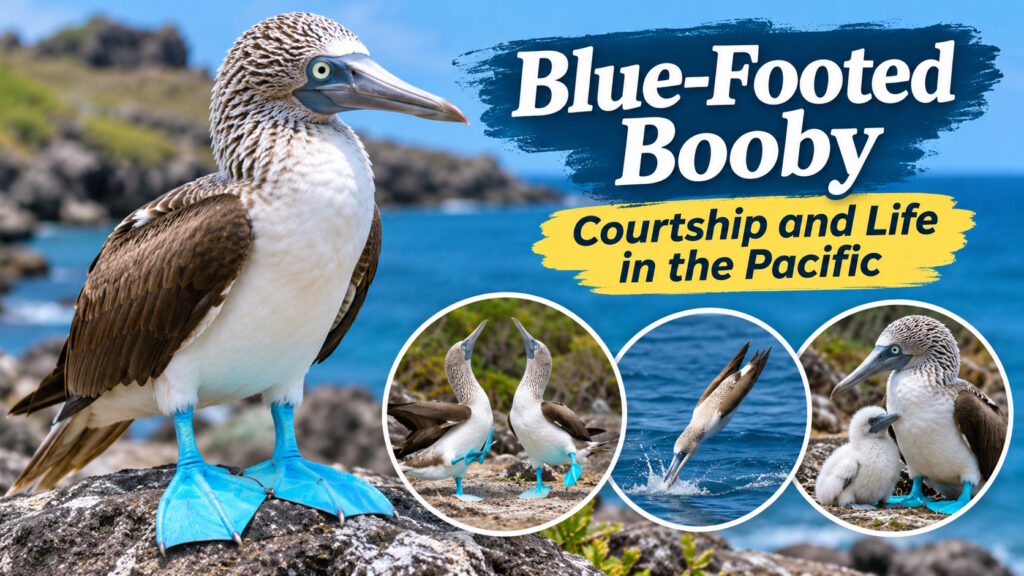
Blue-Footed Booby: Courtship and Life in the Pacific
The blue-footed booby (Sula nebouxii) is one of the Pacific Ocean’s most recognizable seabirds. Famous for its bright blue feet, unusual courtship dance, and remarkable diving abilities, this distinctive bird is especially associated with the Galápagos Islands.


Quick Facts
- Scientific name: Sula nebouxii
- Family: Sulidae
- Habitat: Eastern tropical and subtropical Pacific
- Diet: Small schooling fish, including sardines and anchovies
- Eggs: Usually one to three
- Famous feature: Bright blue webbed feet
Why Are Blue-Footed Boobies’ Feet Blue?
The extraordinary blue color comes from the structure of the skin together with pigments linked to the bird’s diet. Foot color can act as a signal of condition and is important during mate choice. The vivid feet are not merely decorative: they help communicate information to potential breeding partners.
The Famous Courtship Dance


During courtship, a male performs a distinctive high-stepping display, slowly lifting one foot after the other to show off its brilliant color. The display may also include sky-pointing, raised wings, whistling calls, and the presentation of nesting materials.
These behaviors help birds assess potential partners and establish a breeding bond. Both males and females may participate in coordinated displays.
Where Do Blue-Footed Boobies Live?
Blue-footed boobies inhabit the eastern Pacific, from western Mexico through Central America to the coasts of Ecuador and Peru. The Galápagos Islands support one of their most famous breeding populations.
They favor coastal islands and open nesting areas where they can access the sea. Unlike tree-nesting seabirds, they commonly establish nests directly on bare ground.
Expert Ocean Hunters


Blue-footed boobies feed primarily on small fish such as anchovies, sardines, and other schooling species. They search for prey while flying over the water, then plunge headfirst toward fish below the surface.
Their streamlined shape and diving adaptations allow them to strike the water at considerable speed. They can forage alone or in groups, sometimes diving together toward the same school of fish.
Nesting and Raising Chicks


Females usually lay one to three eggs in a simple ground nest. Both parents incubate the eggs and care for the young. Rather than using a featherless brood patch like many birds, boobies can warm their eggs with their richly supplied webbed feet.
Chicks hatch covered in pale down and depend on their parents for protection and regurgitated fish. During times of food shortage, older chicks may outcompete younger siblings for food.
Communication and Social Life
Blue-footed boobies communicate using gestures and distinctive vocalizations. Males often produce whistling calls, while females make deeper honking sounds. Courtship displays and calls help coordinate pairing and breeding behavior.
Partners may reunite in later breeding periods, although pair bonds are not necessarily lifelong.
Conservation and Environmental Challenges
The blue-footed booby is globally classified as Least Concern, but local populations can experience environmental pressures. Changes in ocean conditions, limited prey supplies, and disturbance around nesting colonies can affect breeding success.
Monitoring marine food webs and protecting important breeding islands remain valuable conservation measures.
Fascinating Blue-Footed Booby Facts
- The name booby is commonly linked to the Spanish word bobo, meaning foolish or silly.
- Blue feet are important signals during courtship.
- Females are generally larger than males.
- These seabirds can make spectacular plunge dives to catch fish.
- Their nests are often simple patches of open ground.
- Both parents help raise their offspring.
Conclusion
With their brilliant blue feet, elaborate courtship dances, dedicated parental care, and impressive hunting skills, blue-footed boobies are among the most fascinating seabirds of the Pacific. Their survival depends on healthy oceans, reliable fish populations, and protected breeding habitats.
References
- Cornell Lab of Ornithology – Life History
- Galapagos Conservation Trust – Blue-footed Booby
- Audubon – Blue-footed Booby
Image credits and licenses are linked in the captions. Images are embedded from Wikimedia Commons.