


Views: 0
Saker Falcon: History, Habitat and Conservation
Birds of Prey | Falconidae | Wildlife & Conservation


9
The Saker Falcon (Falco cherrug), known in Arabic as الصقر الحر, is one of the most celebrated birds of prey in the world. Renowned for its strength, hunting ability and remarkable adaptability, it has played an important role in traditional falconry for centuries, particularly across the Arabian Peninsula and Central Asia.
Yet this magnificent raptor faces a serious conservation challenge. Despite its cultural importance and broad geographical range, the Saker Falcon is classified as Endangered by the International Union for Conservation of Nature (IUCN).
DOI
+1
Saker Falcon: Quick Facts
| Feature | Details |
|---|---|
| Scientific name | Falco cherrug |
| Arabic name | الصقر الحر |
| Family | Falconidae |
| Length | Approximately 45–60 cm |
| Wingspan | Approximately 105–130 cm |
| Diet | Rodents, birds and other small animals |
| Preferred habitat | Grasslands, steppes and semi-deserts |
| Distribution | Europe and Asia, with wintering populations farther south |
| Conservation status | Endangered |
| Population trend | Decreasing |
1. History and Cultural Importance
The Saker Falcon has a distinguished place in the history of falconry. For generations, hunters across the Middle East and Central Asia have valued this bird for its endurance, strength and ability to pursue prey across open terrain.
In Arabian culture, the Saker Falcon represents patience, skill and the relationship between people and the natural environment. Traditional falconry knowledge includes understanding bird behavior, seasonal migrations, training and responsible care.
The Saker Falcon is also associated with the hunting traditions of Central Asian societies, where vast grasslands provide ideal conditions for powerful, long-winged falcons.
Today, falconry continues to be an important cultural tradition, while conservation organizations increasingly emphasize captive breeding, traceable legal ownership and the protection of wild populations.
2. Physical Appearance and Identification


10
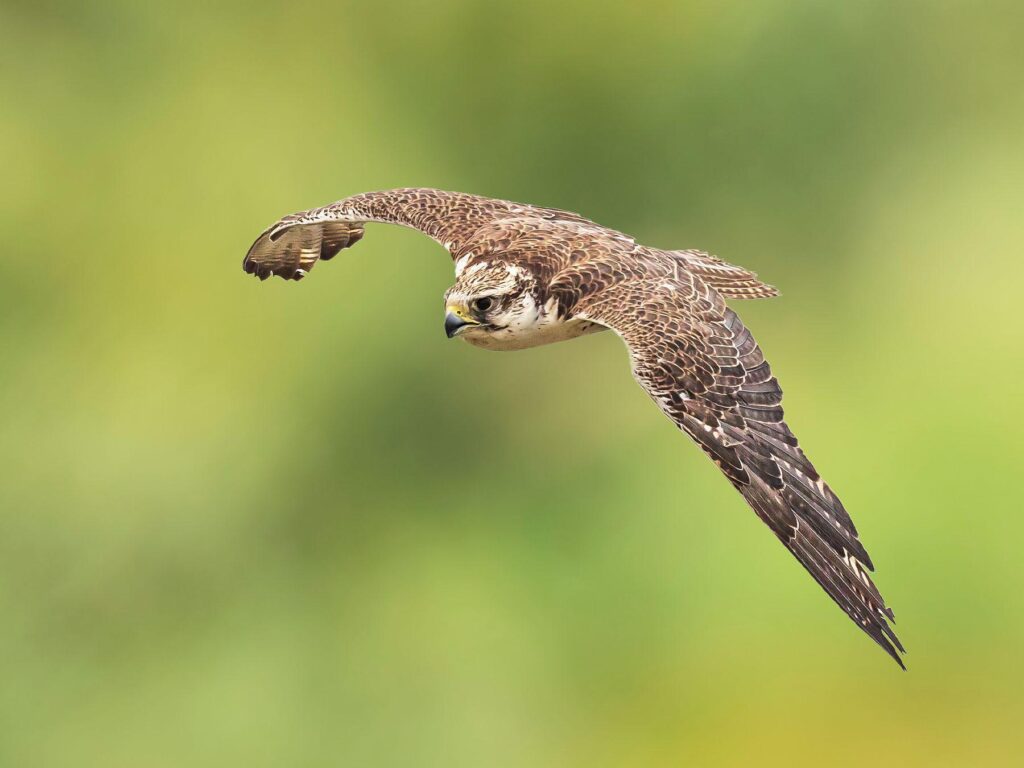
Saker Falcons are large, robust falcons with broad wings and a relatively long tail. Their appearance varies considerably between individuals.
Typical features include:
- Brown upperparts with pale feather edges.
- Cream-colored underparts with dark streaking.
- A pale or buff head, sometimes with darker markings.
- Powerful feet and sharp talons.
- A strongly hooked beak designed for handling prey.
Females are generally larger and heavier than males. Young birds often have more prominent streaking than adults.
Unlike the Peregrine Falcon, which frequently captures birds in spectacular high-speed dives, the Saker is especially well adapted to active pursuit in open landscapes.
3. Natural Habitat and Geographic Distribution


5
Saker Falcons inhabit expansive open landscapes where they can locate and pursue prey effectively.
Their breeding range stretches from parts of Central and Eastern Europe through Central Asia toward China and Mongolia.
Typical habitats include grassland, steppe, semi-desert, agricultural land and open mountainous terrain. Scattered trees, cliffs and other elevated nesting locations are particularly valuable.
Some Saker Falcons remain near their breeding territories throughout the year, while others migrate south during winter, reaching the Middle East, South Asia and parts of Africa.
Fauna & Flora
+1
4. Hunting Techniques and Diet


10
Saker Falcons are highly effective predators that use speed, agility and powerful flight to capture prey.
They frequently hunt ground-dwelling mammals such as voles, ground squirrels and other rodents. They also take birds, including pigeons and other species found in open habitats.
Rather than relying exclusively on steep aerial dives, Sakers often use low, fast pursuit flights. Their long wings help them cover considerable distances while searching for prey.
This predatory role is ecologically important because it helps regulate populations of small animals across grassland ecosystems.
5. Breeding and Life Cycle
Saker Falcons usually do not construct elaborate nests of their own. Instead, they often occupy abandoned nests built by other large birds, including ravens and raptors, or use suitable cliff ledges.
Females commonly lay around three to five eggs, although clutch size varies. Both parents contribute to raising the young, with the female typically undertaking much of the incubation and early brooding.
Young falcons gradually develop their flight and hunting skills before becoming independent.
Successful breeding depends on sufficient prey, safe nesting sites and limited disturbance during the nesting season.
6. Conservation Status and Major Threats
Endangered
IUCN Red List, 2021 assessment
Estimated mature individuals
12,200–29,800
Global population trend
Decreasing
The population estimate is based largely on historical surveys synthesized in the IUCN’s 2021 assessment, rather than a new 2026 census.
DOI
The main threats to Saker Falcons include illegal capture and trade, electrocution on power infrastructure, habitat degradation, poisoning, and declining prey availability.
Illegal removal of wild birds remains a particularly serious concern. High demand for valuable falcons can place significant pressure on breeding populations, especially where monitoring and enforcement are inadequate.
Electricity infrastructure creates another danger. Falcons perching on poorly designed power poles can be electrocuted, a threat that can be reduced through safer engineering and insulation.
Fauna & Flora
+1
7. Conservation Efforts in the UAE and Worldwide
The United Arab Emirates has contributed to international Saker Falcon conservation through research, nesting programs and cooperation with countries across the species’ natural range.
The Environment Agency – Abu Dhabi reports that an initiative to establish approximately 5,000 artificial nesting sites in Mongolia has provided breeding opportunities where suitable natural nests were limited.
The Sheikh Zayed Falcon Release Programme, established in 1996, has also supported the return of more than 1,000 falcons to the wild, according to the agency.

EAD
Internationally, the Convention on Migratory Species developed the Saker Falcon Global Action Plan to coordinate research, monitoring and sustainable management.
The international conservation effort remained active in 2026, with an updated Global Action Plan document published under the Convention on Migratory Species in March.

CMS
+1
Protecting the species requires cooperation among governments, researchers, conservation organizations and falconers.
8. Interesting Facts About the Saker Falcon
- Saker Falcons are among the largest members of the falcon family.
- They display considerable variation in feather coloration, from darker brown to unusually pale individuals.
- Many populations rely heavily on ground-dwelling mammals.
- They often reuse nests originally constructed by other birds.
- Some migrate thousands of kilometers between breeding and wintering grounds.
- They have been valued in traditional falconry for centuries.
- They are an important focus of international raptor conservation.
9. The Future of the Saker Falcon
The future of the Saker Falcon depends on protecting wild habitats, reducing preventable deaths, maintaining healthy prey populations and ensuring that demand for falconry birds does not contribute to illegal capture.
Conservation successes demonstrate that coordinated action can make a difference. Artificial nest programs, safer electricity infrastructure, scientific tracking and responsibly managed captive breeding all have potential roles.
Ultimately, preserving the Saker Falcon means protecting not only a remarkable predator but also an important part of the natural and cultural heritage of Eurasia and the Arabian Peninsula.
SEO and Publishing Package
Recommended website
birds.bin3aiah.net
SEO title
Saker Falcon: History, Habitat, Hunting & Conservation
Suggested URL slug
saker-falcon-history-habitat-conservation
Meta description
Discover the Saker Falcon’s history, habitat, hunting abilities, cultural importance and conservation challenges facing this endangered bird.
Focus keyword
Saker Falcon
Secondary keywords
Falco cherrug, Saker Falcon habitat, Saker Falcon conservation, الصقر الحر, falconry birds
Categories
Birds of Prey, Falcons, Wildlife Conservation
Tags
Saker Falcon, Falconidae, Raptors, Falconry, UAE Wildlife, Endangered Birds
Suggested Photo Gallery


12
Visual gallery references for a 10-image article. Usage licenses and photographer credits must be checked before images are uploaded or republished.
Video References
For the website’s three-video requirement, these are useful subjects to source from reputable wildlife organizations:
- Saker Falcon wildlife documentary
- Saker Falcon conservation in Mongolia
- Saker Falcon hunting and flight
These are video search links, not individually verified videos or approved embeds.
Research Sources
- IUCN Red List — Saker Falcon
- Environment Agency – Abu Dhabi
- Convention on Migratory Species
- Fauna & Flora — Saker Falcon
Publishing status: Article and SEO material prepared for Bin3aiah Birds. Images and video references are identified, but media rights and embeds still require verification. The article has not been published to WordPress.