


Views: 0
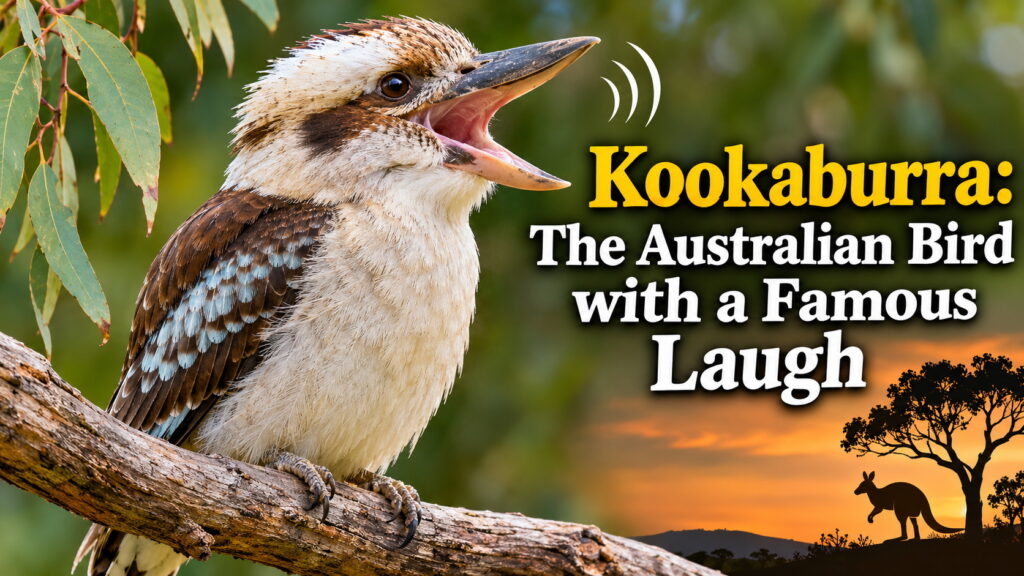
Kookaburra: The Australian Bird with a Famous Laugh
The Laughing Kookaburra (Dacelo novaeguineae) is one of Australia’s most recognizable birds, celebrated for its remarkable call that sounds like human laughter. Its rolling, cheerful-sounding chorus is an iconic part of the Australian bush, frequently heard at dawn and dusk.
Behind that famous laugh is an intelligent, territorial, and highly skilled predator with fascinating social behavior and close family relationships.


Quick Facts About the Kookaburra
| Scientific name | Dacelo novaeguineae |
|---|---|
| Family | Alcedinidae (Kingfishers) |
| Length | Approximately 40–47 cm |
| Native range | Eastern Australia |
| Habitat | Forests, woodlands, parks and gardens |
| Diet | Insects, reptiles, frogs, small mammals and birds |
| Distinctive feature | Loud, laughter-like territorial call |
| Nesting | Tree hollows and occasionally termite nests |
Why Does the Kookaburra Laugh?
The kookaburra’s famous laughter is not a sign of happiness or amusement. It is primarily a territorial call that helps family groups communicate with neighboring birds.
The performance often begins with a series of quiet chuckles before developing into a loud, rolling chorus. Several family members may join the call, producing a sound that resembles a group of people laughing together.
These vocalizations help kookaburras announce ownership of their territory, maintain family communication, and warn rivals to stay away. Calls are especially noticeable around sunrise and sunset, earning the kookaburra its reputation as a natural alarm clock of the Australian bush.


Appearance and Physical Characteristics
The laughing kookaburra is a robust bird with a large head, powerful pointed beak, brown upperparts, and a creamy-white chest. A dark stripe runs across its eyes, while its wings show pale-blue markings.
Its short legs and sturdy body are well suited to spending long periods perched above the ground. The powerful beak is especially useful for capturing, carrying, and subduing prey.
Although kookaburras belong to the kingfisher family, they differ from many fish-eating relatives because they primarily hunt land animals.
Hunting Techniques and Diet
Despite its entertaining voice, the kookaburra is a formidable carnivorous hunter. It often waits quietly on a branch, fence post, or other elevated lookout, carefully observing the ground below.
When suitable prey appears, the bird swoops down and captures it with its strong beak. Its diet includes large insects, worms, lizards, frogs, small snakes, mice, and occasionally small birds.
Larger prey may be struck repeatedly against a branch or another hard surface before being swallowed. This helps the kookaburra subdue animals that are too large or difficult to consume immediately.


Family Life and Cooperative Parenting
One of the most fascinating features of laughing kookaburras is their cooperative family structure. Breeding pairs often maintain long-term partnerships, while some older offspring remain in the family territory instead of immediately establishing their own.
These older birds may help their parents defend the territory and raise younger chicks. This cooperative breeding system improves the family’s ability to protect its nesting area and provide food to developing young.
Kookaburras generally nest inside naturally occurring tree hollows, where females commonly lay two or three eggs. Adults and helpers contribute to caring for the young until they become increasingly independent.
Where Do Kookaburras Live?
Laughing kookaburras are native to eastern Australia, where they inhabit eucalyptus forests, open woodlands, forest edges, and suburban areas with suitable trees.
They have also been introduced to Tasmania, southwestern Western Australia, and parts of New Zealand.
These birds rely on elevated perches for hunting and suitable hollows for nesting. Mature trees therefore play an important role in maintaining healthy local populations.

Interesting Facts About Kookaburras
- They are kingfishers: Despite their different hunting habits, kookaburras belong to the same bird family as other kingfishers.
- Their laugh has a purpose: Loud calling helps family groups defend territories.
- They are patient hunters: Kookaburras often observe prey from a high perch before launching an attack.
- They have strong family bonds: Older offspring may help feed and protect younger chicks.
- Their voices are famous worldwide: Kookaburra calls have appeared in movie soundtracks to create the impression of a jungle environment.
- They thrive near people: Some individuals adapt to gardens, parks, and wooded urban neighborhoods.
Conservation and Environmental Importance
The laughing kookaburra remains relatively widespread, but habitat clearing, the removal of old nesting trees, and local ecological changes can affect its populations.
Protecting native woodland, preserving hollow-bearing trees, and maintaining healthy food webs can help support kookaburras and many other Australian animals.
As predators, kookaburras also contribute to ecosystem balance by consuming insects and small vertebrates.
Conclusion
The laughing kookaburra is much more than a bird with a memorable voice. Its remarkable territorial calls, effective hunting techniques, and cooperative family relationships make it one of the most fascinating birds in Australia.
Whether perched quietly in a eucalyptus tree or filling the forest with its unmistakable laughter, the kookaburra remains an enduring symbol of Australia’s extraordinary wildlife.
References and Further Reading
- Australian Museum – Laughing Kookaburra
- BirdLife Australia
- Wikimedia Commons – Laughing Kookaburra Image Collection
Published by Bin3aiah Birds – Exploring the fascinating world of birds and wildlife.