


Views: 0
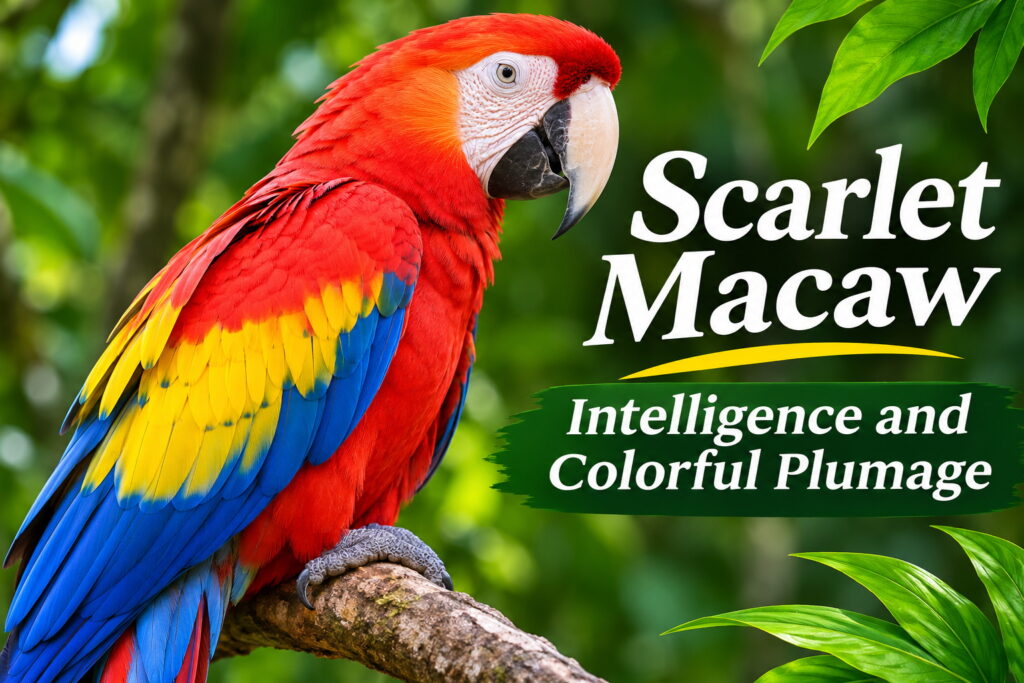
Scarlet Macaw: Intelligence and Colorful Plumage
The Scarlet Macaw (Ara macao) is one of the most spectacular parrots in the world. Famous for its brilliant red, yellow, and blue feathers, this remarkable bird combines extraordinary beauty with intelligence, social behavior, and impressive adaptations to tropical forest life.
Native to Central and South America, scarlet macaws inhabit rainforests and wooded landscapes where they form strong social bonds, communicate through powerful calls, and use their specialized beaks to access a wide variety of foods.


Scarlet Macaw Quick Facts
| Scientific name | Ara macao |
|---|---|
| Family | Psittacidae |
| Length | Approximately 85 cm, including tail |
| Weight | Approximately 1–1.2 kg |
| Lifespan | Several decades; up to about 60 years in captivity |
| Diet | Fruits, seeds, nuts, flowers and plant material |
| Habitat | Tropical forests and wooded habitats |
| Conservation status | Least Concern, with a declining global population |
1. A Masterpiece of Colorful Plumage
The scarlet macaw’s vivid feathers make it instantly recognizable. Most of its head, neck, chest, and body are bright scarlet red. Its wings display broad yellow patches and deep blue flight feathers, while some individuals show touches of green between these colors.
Its long, tapering tail adds to its impressive silhouette during flight. Unlike many other bird species, male and female scarlet macaws appear very similar, making them difficult to distinguish visually.
The colorful feathers are more than decorative. Plumage plays an important role in communication, species recognition, and visual displays between birds.
2. Intelligence and Problem-Solving Abilities
Scarlet macaws are intelligent parrots with sophisticated learning abilities. Their curious nature encourages them to explore objects, manipulate food, and interact with their surroundings.
Like other parrots, scarlet macaws are capable of learning through observation and experience. They can recognize familiar individuals, develop learned routines, and demonstrate flexible behavior when confronted with environmental challenges.
Examples of Scarlet Macaw Intelligence
- Problem-solving: Exploring different ways to manipulate objects and obtain food.
- Vocal learning: Learning to imitate sounds, including some human speech.
- Social recognition: Recognizing familiar companions and maintaining relationships.
- Memory: Remembering useful feeding locations and learned behaviors.
- Environmental exploration: Investigating unfamiliar objects and responding to changes.
Although macaws can imitate human sounds, vocal imitation should not automatically be interpreted as human-like language comprehension.


3. Natural Habitat and Distribution
Scarlet macaws occur from southern Mexico through parts of Central America and across significant areas of tropical South America.
They inhabit lowland rainforests, gallery forests, and other wooded environments. Their preferred surroundings often provide large trees, abundant food, and natural cavities suitable for nesting.
These parrots spend much of their time in the forest canopy, where they travel between feeding areas and resting sites.
In some regions, scarlet macaws are also observed around forest edges, rivers, and open woodland.
4. Diet and Powerful Beak
The scarlet macaw possesses a large, strong, curved beak that enables it to crack nuts, open hard seed coverings, and manipulate different foods.
Its natural diet includes fruits, seeds, nuts, flowers, and other plant materials, depending on seasonal availability.
Strong feet and flexible toes allow macaws to hold food while their beaks break it apart. Their feet are also valuable for climbing and gripping branches.
Through their feeding activities, scarlet macaws participate in important forest ecological processes, including seed consumption and occasional seed dispersal.
5. Social Behavior and Communication
Scarlet macaws are highly social birds that are frequently observed in pairs or small groups. They can also gather in larger flocks near feeding areas and communal gathering sites.
Communication relies heavily on loud calls, body posture, feather movements, and social interactions.
Their powerful vocalizations are especially useful for maintaining contact in dense rainforest environments, where visibility may be limited.
Strong Pair Bonds
Scarlet macaws are known for forming enduring pair relationships. Partners may remain close while feeding, traveling, and resting.
Mutual grooming and other affiliative behaviors help maintain these relationships.

6. Breeding and Parenting
Scarlet macaws typically select natural cavities in large trees for nesting. Such locations provide an elevated, relatively sheltered environment for eggs and developing chicks.
A typical clutch contains two to four eggs. The female usually performs most of the incubation, while the male helps provide food and supports the breeding pair.
After hatching, chicks remain dependent on their parents for nourishment and protection.
Young macaws require considerable time to develop the physical coordination and behavioral skills necessary for independent life. Family associations can continue after the young leave the nest.


7. Threats and Conservation
Although the scarlet macaw is currently classified as Least Concern on the IUCN Red List, populations are declining in several regions.
Deforestation and habitat fragmentation reduce the availability of suitable nesting trees and feeding areas.
Illegal trapping for the wildlife trade has also contributed to local population declines and disappearances.
Conservation Priorities
- Protect tropical rainforest habitats and mature nesting trees.
- Prevent illegal capture and wildlife trafficking.
- Support habitat restoration and protected areas.
- Encourage responsible wildlife tourism.
- Support scientifically managed conservation and reintroduction initiatives where appropriate.
Scarlet macaws are listed under CITES Appendix I, which provides strict controls on international commercial trade in wild specimens.
8. Fascinating Scarlet Macaw Facts
- Scarlet macaws are among the most colorful large parrots.
- Their long tails contribute significantly to their total body length.
- They have powerful beaks capable of cracking hard nuts and seeds.
- They frequently form long-lasting pair bonds.
- They can imitate sounds and learn complex routines.
- Their feet help them manipulate food almost like an additional pair of hands.
- They require large forest trees for many of their nesting opportunities.
- They can live for several decades.
- Their loud calls help keep flock members connected.
- Conserving scarlet macaws also helps protect tropical forest biodiversity.
Conclusion
The Scarlet Macaw represents an extraordinary combination of colorful plumage, intelligence, and social complexity. From its striking feathers to its impressive problem-solving abilities and strong family relationships, this tropical parrot demonstrates the remarkable diversity of bird life.
Preserving scarlet macaws requires continued protection of rainforest habitats, responsible conservation efforts, and action against illegal wildlife trafficking.
By safeguarding these extraordinary birds, we also contribute to the protection of the ecosystems they call home.