


Views: 0
Nicobar Pigeon: The Brilliantly Colored Island Bird


The Nicobar pigeon (Caloenas nicobarica) is one of the most visually spectacular birds in the pigeon family. Its shimmering green, metallic blue and copper-colored feathers make it look remarkably different from the pigeons commonly seen in cities.
Native to tropical islands across Southeast Asia and the western Pacific, this beautiful bird is known for its colorful plumage, long neck feathers, strong flight ability and fascinating evolutionary relationship with the extinct dodo.
Nicobar Pigeon: Quick Facts
| Scientific Name | Caloenas nicobarica |
|---|---|
| Family | Columbidae |
| Body Length | Approximately 38–40 cm |
| Weight | Up to approximately 600 g |
| Habitat | Tropical forests, coastal woodland and mangroves |
| Diet | Fruits, seeds and small invertebrates |
| Distribution | Nicobar Islands, Southeast Asian islands and western Pacific |
| Conservation Status | Near Threatened (IUCN) |
| Notable Feature | Iridescent feathers and elongated neck hackles |
A Bird with Extraordinary Colors
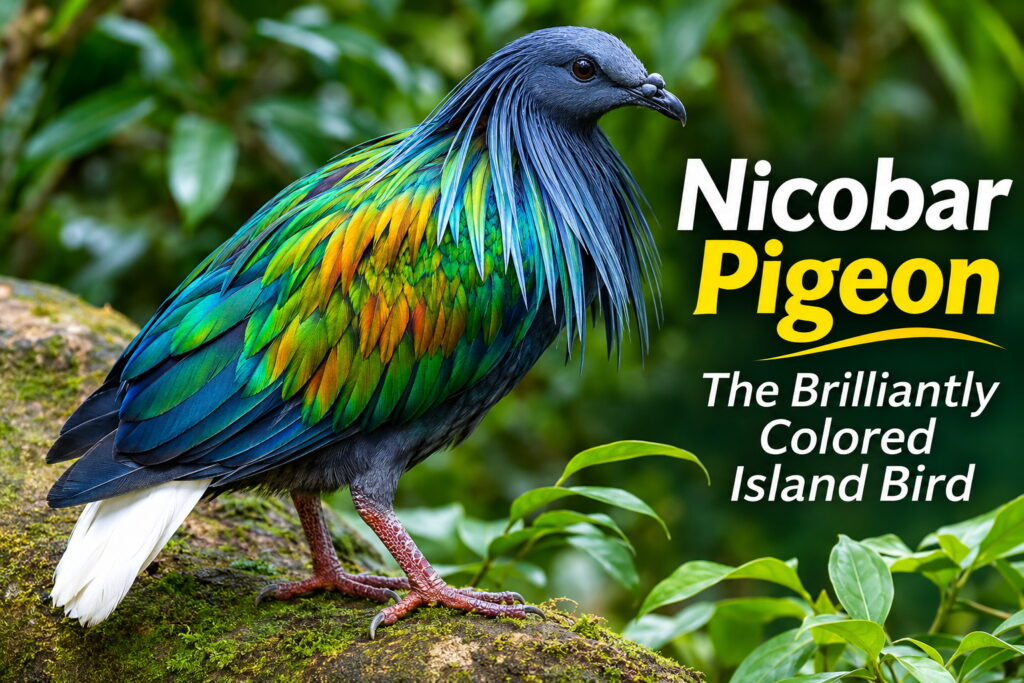
The Nicobar pigeon’s most striking feature is its brilliant iridescent plumage. Depending on the angle of sunlight, the bird’s feathers appear emerald green, deep blue, bronze or copper.
These colors are created largely by microscopic structures within the feathers that reflect light in different ways.
The bird also has elongated feathers around its neck, forming a flowing mane. Its dark gray head, dark bill, reddish legs and contrasting white tail complete its distinctive appearance.


Where Does the Nicobar Pigeon Live?
The Nicobar pigeon inhabits islands stretching from the Andaman and Nicobar region through the Malay Archipelago and toward the Solomon Islands and Palau.
Its preferred environments include tropical lowland forests, coastal woodland, mangroves and relatively undisturbed offshore islands.
Unlike many urban pigeons, this species is strongly associated with island habitats. It often travels between islands in search of food and suitable nesting or roosting sites.
Its powerful flight allows it to cross stretches of open water, while its forest-floor feeding habits help it exploit food resources beneath tropical trees.
Diet and Feeding Habits
Nicobar pigeons spend much of their feeding time walking along the forest floor, searching for fallen fruits, seeds and other edible materials.
Their diet includes:
- Fallen tropical fruits
- Seeds and hard plant material
- Buds and other plant matter
- Occasional insects and small invertebrates
An interesting adaptation is the pigeon’s powerful muscular gizzard, which helps break down hard food. Small swallowed stones may assist the grinding process.
By consuming fruit and moving between feeding areas, these birds may contribute to seed dispersal within tropical island ecosystems.
Behavior and Island Lifestyle
Nicobar pigeons are sociable birds that may form flocks and travel between neighboring islands.
They are frequently seen walking on the ground, but they are also strong flyers capable of traveling substantial distances over water.
Offshore islands can offer relatively secure places to roost and breed, especially where large terrestrial predators are absent.
Although their bright feathers are highly noticeable in direct sunlight, the darker green and bronze shades can blend with the shadows of tropical vegetation.


Breeding and Reproduction
Nicobar pigeons often breed in colonies, sometimes with several nests located in the same tree.
Their nests are relatively simple platforms made from twigs and plant material. Suitable breeding sites are especially important because island nesting colonies can be vulnerable to disturbance and introduced predators.
Like other members of the pigeon family, adult Nicobar pigeons produce a nutritious substance called crop milk to feed their young during the early stages of development.
Parental care helps chicks develop until they are capable of feeding independently.
The Nicobar Pigeon and the Extinct Dodo
One of the most fascinating facts about the Nicobar pigeon is its evolutionary connection to the extinct dodo (Raphus cucullatus).
Genetic studies place the Nicobar pigeon among the closest living relatives of the dodo and the extinct Rodrigues solitaire.
Although the dodo was a large, flightless bird from Mauritius, the Nicobar pigeon remains a strong flyer with a considerably smaller body and very different plumage.
This relationship demonstrates how closely related bird lineages can evolve dramatically different appearances and lifestyles after adapting to different island environments.
Conservation Status: Near Threatened
The Nicobar pigeon is classified as Near Threatened on the IUCN Red List. Although the species still occurs across a broad geographic region, conservation concerns remain.
Important threats include:
- Habitat destruction: Forest clearing and coastal development reduce suitable feeding and nesting habitat.
- Hunting: Birds may be hunted for food in parts of their range.
- Wildlife trade: Capture for the pet trade creates additional pressure.
- Introduced predators: Rats, cats and other non-native predators threaten island bird populations.
The Nicobar pigeon is also included in CITES Appendix I, which places strict controls on international commercial trade in wild specimens.
Protecting tropical forests, maintaining secure breeding islands and preventing illegal capture are important steps toward safeguarding this remarkable species.
Interesting Nicobar Pigeon Facts
- It is one of the most colorful members of the pigeon family.
- Its metallic-looking feathers change appearance under different lighting conditions.
- Its elongated neck feathers form a distinctive decorative mane.
- It regularly travels between tropical islands.
- It is among the closest living relatives of the extinct dodo.
- It uses a muscular gizzard to process hard food.
- It has a contrasting white tail that becomes especially noticeable in flight.
Why Protecting This Bird Matters
The Nicobar pigeon represents the extraordinary diversity of life found on tropical islands. Its brilliant appearance, unusual evolutionary history and ecological role make it a valuable part of island biodiversity.
Protecting this species also helps conserve the coastal forests, mangroves and smaller island habitats used by many other animals.
By maintaining healthy island ecosystems, conservation efforts can help ensure that future generations continue to encounter one of the world’s most beautiful pigeons.
References and Further Reading
- Belfast Zoo – Nicobar Pigeon
- Ocean Park Hong Kong – Nicobar Pigeon
- Gdansk Zoo – Distribution and Behavior
- National Aviary – Near Threatened Birds
Explore more wildlife and bird species at Bin3aiah Birds.