


Views: 4
Great Grey Owl: The Silent Hunter of Northern Forests
Deep within the snowy forests of the Northern Hemisphere lives one of nature’s most extraordinary birds of prey: the Great Grey Owl (Strix nebulosa). With its enormous facial disc, piercing yellow eyes and almost silent flight, this remarkable owl is perfectly adapted to hunting in the northern wilderness.


Great Grey Owl: Quick Facts
| Scientific Name | Strix nebulosa |
| Common Name | Great Grey Owl / Great Gray Owl |
| Family | Strigidae |
| Body Length | Approximately 61–84 cm |
| Wingspan | Approximately 1.3–1.5 metres |
| Habitat | Boreal and mountain forests |
| Distribution | North America, Europe and Asia |
| Diet | Voles, mice and other small mammals |
| Activity | Dawn, dusk and sometimes daylight |
| Conservation | Least Concern globally |
1. A Giant Among Owls
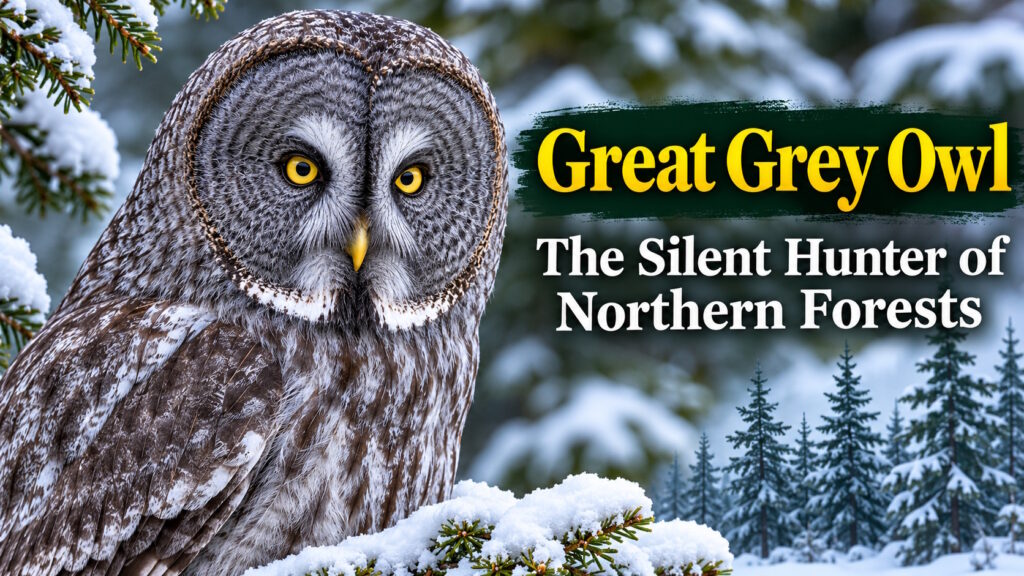
The Great Grey Owl is the world’s longest owl species. Its impressive appearance comes largely from its extremely thick plumage, which helps protect it from the freezing temperatures of northern forests.
Despite its imposing size, it weighs considerably less than some other large owls, including the Eurasian Eagle-Owl.
Its remarkable appearance includes:
- Large concentric facial rings
- Bright yellow eyes
- Grey and brown camouflage feathers
- A small white bow-tie-shaped marking below its beak
- A relatively long tail
- Broad wings adapted for slow, controlled flight


2. The Science of Silent Flight
One of the most extraordinary adaptations of the Great Grey Owl is its nearly silent flight.
Specialized feathers along its wings reduce aerodynamic noise. This allows the owl to approach prey without easily being detected and helps it hear subtle sounds while flying.
Its broad wings also provide lift at relatively slow speeds, allowing controlled movement through forest clearings and snowy landscapes.


3. Hunting Beneath the Snow
The Great Grey Owl is especially famous for its exceptional hearing.
Its large facial disc helps channel sound toward its ears. The asymmetrical positioning of its ear openings assists in pinpointing the location of prey that cannot be seen.
During winter, small rodents often move through tunnels beneath the snow. The owl listens carefully from an elevated perch before launching its attack.
A typical hunt involves:
- Waiting silently on a suitable perch.
- Listening for rodents moving beneath the snow.
- Determining the direction of the sound.
- Gliding toward the estimated prey location.
- Plunging into the snow with its powerful talons.
This remarkable strategy allows the owl to capture prey that is entirely hidden beneath the winter landscape.
4. Life in Northern Forests
Great Grey Owls inhabit extensive northern forests across Canada, Alaska, Scandinavia, Russia and parts of the northern United States.
They favor landscapes that combine mature forest with open hunting areas such as meadows, bogs and forest clearings.
Large trees provide nesting and resting locations, while open spaces support populations of voles and other small mammals.


5. Breeding and Raising Young
Unlike many other birds, Great Grey Owls generally do not build their own nests.
Instead, they often use abandoned nests constructed by other large birds, including ravens and raptors. They may also nest on the tops of broken trees.
Females typically lay two to five eggs, although clutch sizes vary with local conditions and food availability.
The female incubates the eggs and protects the young, while the male supplies much of the food during the early stages of breeding.
When rodent populations decline, breeding success may fall significantly.
6. Adaptations for Extreme Winters
Surviving in the northern wilderness requires several extraordinary adaptations.
- Thick plumage: Helps retain body heat.
- Feathered feet: Provide insulation against cold temperatures.
- Exceptional hearing: Detects hidden prey.
- Camouflage: Helps the owl blend into tree bark and forest shadows.
- Broad wings: Support controlled, quiet flight.
7. Conservation and Environmental Challenges
The Great Grey Owl is classified globally as a species of Least Concern, but certain regional populations face conservation challenges.
Major potential threats include:
- Loss of mature forest habitats
- Forest fragmentation
- Removal of suitable nesting trees
- Collisions with vehicles
- Changes in rodent populations
- Climate-related habitat changes
Protecting mature forests together with suitable open hunting habitats is important for maintaining healthy populations.
8. Fascinating Great Grey Owl Facts
- It is the world’s longest owl species.
- Its huge appearance is partly due to thick feathers.
- It can locate rodents beneath snow using sound.
- Its facial disc acts as a specialized sound collector.
- Its wing structure minimizes flight noise.
- It can be active during daylight hours.
- It sometimes travels beyond its usual range when prey becomes scarce.
- It usually occupies nests or nesting structures made by other animals.
Conclusion
The Great Grey Owl represents one of nature’s finest examples of adaptation to extreme northern environments.
Its extraordinary hearing, nearly silent wings, remarkable camouflage and ability to hunt beneath snow make it one of the most fascinating birds of prey in the world.
By protecting northern forests and the ecosystems that support them, we can help preserve this magnificent silent hunter for future generations.
Discover remarkable birds, their habitats, unique adaptations and fascinating behaviors on Bin3aiah Birds.
Sources and Further Reading
- Cornell Lab of Ornithology — Great Gray Owl
- National Audubon Society — Great Gray Owl
- US National Park Service — Great Gray Owl
- Wikimedia Commons — Great Grey Owl Photographs
Image credits: Wikimedia Commons contributors. Check each image’s individual attribution and license requirements before commercial republication.