


Views: 8
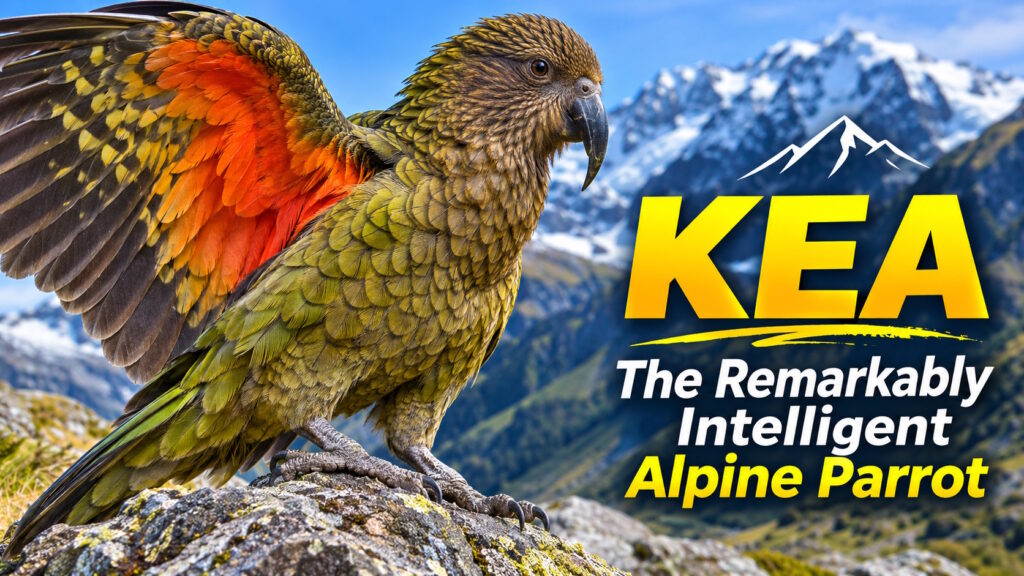
Kea: The Remarkably Intelligent Alpine Parrot
Meet the kea (Nestor notabilis), New Zealand’s extraordinary mountain parrot, renowned for its intelligence, playful curiosity, and remarkable ability to solve problems.


High among the rugged mountains of New Zealand’s South Island lives one of the world’s most fascinating birds: the kea. Unlike most parrots, which are associated with tropical environments, this remarkable species is adapted to alpine landscapes, forests, cold weather, and challenging terrain.
Its intelligence, social behaviour, and extraordinary curiosity have made the kea an important subject of scientific research. From solving complex puzzles to investigating unfamiliar objects, kea demonstrate impressive cognitive flexibility.
1. Kea: Quick Facts
| Feature | Details |
|---|---|
| Common Name | Kea |
| Scientific Name | Nestor notabilis |
| Family | Strigopidae |
| Native Region | South Island, New Zealand |
| Body Length | Approximately 46–50 cm |
| Weight | Approximately 700–1,000 g |
| Diet | Omnivorous |
| Habitat | Forests, alpine grasslands, mountain valleys |
| Conservation Status | Endangered (IUCN) |
| Famous For | Intelligence, curiosity and problem-solving |
2. Appearance: Built for Alpine Life
The kea has an unmistakable appearance. Its olive-green plumage features finely patterned feathers, while brilliant orange-red feathers remain concealed beneath its wings until it takes flight.
Its most distinctive physical characteristics include:
- Long, curved beak: Useful for probing, manipulating objects, and extracting food.
- Powerful feet: Help the bird climb, grasp and investigate objects.
- Olive-green plumage: Provides camouflage among vegetation and mountain environments.
- Orange underwings: Create dramatic flashes of colour during flight.
- Strong wings: Enable flight through rugged mountain terrain.


3. Why Is the Kea So Intelligent?
The kea is widely recognised as an exceptionally intelligent bird. Its ability to explore, experiment, learn, and solve unfamiliar problems distinguishes it from many other species.
Problem-Solving Abilities
Researchers have demonstrated that kea can learn how physical mechanisms work, manipulate unfamiliar objects, and solve problems involving multiple steps.
These abilities are particularly valuable in environments where food sources and environmental conditions constantly change.
Innovative Tool Use
Although tool use is not an everyday behaviour for every kea, scientists have documented remarkable examples.
A kea named Bruce, which had lost much of its upper beak, was observed deliberately selecting pebbles and using them to preen its feathers. This unusual behaviour demonstrated flexible problem-solving and innovative object use.
Learning Through Play
Young kea frequently play with objects and interact with other birds. Such activities may help develop physical skills, exploratory behaviour, and social abilities.
Social Intelligence
Kea live in flexible social groups and engage in complex interactions. They can acquire information from other birds and adjust their behaviour in response to changing circumstances.
4. Habitat: The Mountains of New Zealand
The kea lives naturally on New Zealand’s South Island, particularly in the Southern Alps and surrounding forests.
Its range includes environments around Arthur’s Pass, Aoraki/Mount Cook, Fiordland, and other mountainous regions.
Although kea are famous for their association with snowy peaks, they are not restricted to high-altitude habitats. They also depend on forests, lower mountain slopes, and sheltered nesting areas.


5. What Does a Kea Eat?
Kea are opportunistic omnivores, consuming a wide variety of plant and animal material.
Their natural diet includes:
- Native fruits and berries.
- Seeds, leaves and roots.
- Nectar and other plant material.
- Insects and insect larvae.
- Animal remains and carrion.
- Occasionally, other small animals.
This dietary flexibility helps kea survive seasonal changes and periods when particular food resources become scarce.
6. The Curious Parrot That Investigates Cars
One of the kea’s most famous behaviours is its tendency to investigate human belongings, vehicles, and equipment.
Kea have been observed exploring backpacks, pulling at vehicle rubber seals, and manipulating loose objects.
These behaviours arise from natural curiosity rather than deliberate mischief. Unfortunately, human interactions may expose kea to dangerous materials, vehicles, and unhealthy food.
Important: Never feed wild kea. Feeding encourages them to associate people with food and increases the risk of dangerous encounters.
7. Social Behaviour and Communication
Kea are highly social birds with a rich variety of vocalisations and behavioural interactions.
They use calls, body posture, play, and other behaviours to interact with members of their species.
The name “kea” comes from the bird’s distinctive call, often described as sounding like “kee-aa”.
Social play can involve chasing, object manipulation, and interactions between younger and older birds. These behaviours contribute to the kea’s reputation as an especially curious and energetic parrot.
8. Breeding and Reproduction
Kea generally construct nests in sheltered cavities beneath rocks, tree roots, or other protected natural structures.
A female commonly lays around four eggs, although clutch sizes vary. Incubation lasts approximately three to four weeks.
Young kea remain dependent on their parents for an extended period, and their development includes considerable exploration and social learning.
Because kea often nest near ground level, eggs, chicks, and adults can be vulnerable to introduced predators.
9. Conservation: Why the Kea Is Endangered
Despite its intelligence and adaptability, the kea faces substantial conservation challenges.
The species is classified as Endangered on the IUCN Red List and is also considered nationally threatened in New Zealand.
Major Threats
- Introduced predators: Stoats and feral cats attack adults, chicks, and eggs.
- Lead poisoning: Kea may ingest lead from buildings and other materials.
- Vehicle collisions: Birds attracted to roads and vehicles can be injured or killed.
- Human conflict: Curiosity may lead to encounters in which birds are harmed.
- Unsafe human food: Feeding can create harmful behaviour and health risks.
New Zealand’s Department of Conservation reports that approximately 70% of monitored kea nests can succeed in areas with effective predator control, compared with 10% or less in areas without such control.
Conservation Initiatives
Conservation organisations are working to protect kea through predator management, reducing lead exposure, wildlife monitoring, and public education.
The Kea Recovery Strategy 2024–2034 provides a long-term framework for supporting the species and improving its survival.
10. Ten Fascinating Kea Facts
- The kea is the world’s only living alpine parrot.
- It is native to New Zealand’s South Island.
- Its bright orange underwing feathers are normally hidden.
- Kea are capable of solving complex physical puzzles.
- They can learn through exploration and social interaction.
- Their strong curved beaks help them investigate unfamiliar objects.
- Young kea are particularly playful and curious.
- They can survive in cold mountain environments.
- The kea won New Zealand’s Bird of the Year competition in 2017.
- Protecting their nests from introduced predators is essential for conservation.
11. How You Can Help Protect Kea
Visitors to kea habitats can make a meaningful difference by following simple wildlife protection practices.
- Never feed wild kea.
- Keep food, rubbish, and loose belongings secure.
- Observe birds from a respectful distance.
- Never encourage kea onto roads or vehicles.
- Support responsible conservation organisations.
- Report injured kea to New Zealand’s Department of Conservation.
Conclusion
The kea is an extraordinary example of intelligence and adaptability in the natural world.
Its ability to solve problems, interact socially, and investigate unfamiliar objects has made it one of the most fascinating birds studied by scientists.
Yet intelligence alone cannot protect this remarkable species from introduced predators, environmental hazards, and harmful human interactions.
By supporting conservation and respecting wild kea, we can help ensure that future generations continue to encounter this remarkable alpine parrot in New Zealand’s mountains.
References and Further Reading
- New Zealand Department of Conservation — Kea
- New Zealand Birds Online — Kea
- Kea Conservation Trust — Kea Facts
Image credits: Bernard Spragg (CC0) and Markus Koljonen (CC BY-SA 3.0), via Wikimedia Commons. Images are linked to their original sources. The CC BY-SA image requires attribution and compliance with its share-alike terms.