


Views: 3
Peacock: Why Its Feathers Are So Colorful
Birds & Wildlife | Bin3aiah Birds | Nature & Science


8
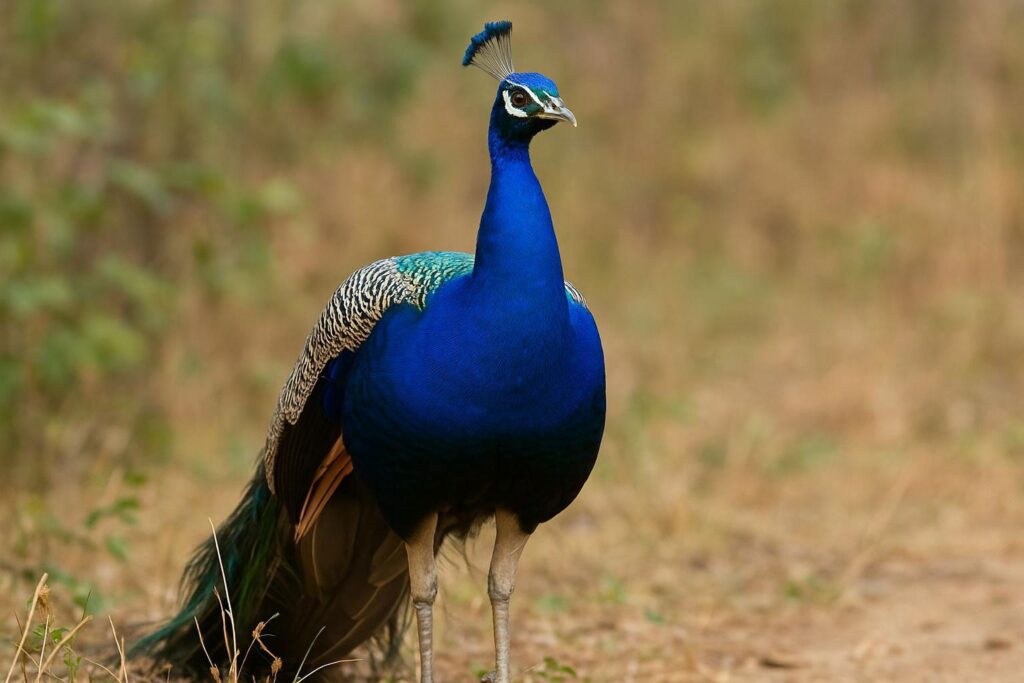
The peacock is one of nature’s most spectacular birds, famous for its dazzling blue and green feathers, enormous fan-shaped display, and beautiful eye-like patterns. But have you ever wondered why its feathers shine with such extraordinary colors?
The secret lies in an incredible combination of microscopic feather structures, the physics of light, and millions of years of evolution.
Unlike many colorful objects, whose appearance comes mainly from pigments, much of the peacock’s brilliant coloration is produced by the way its feathers interact with light.
1. The Science Behind Peacock Feather Colors
Peacock feathers contain microscopic structures that reflect certain wavelengths of light, producing a phenomenon called structural coloration.
Inside the feathers, tiny arrangements of keratin and melanin-containing structures influence how light waves interact. Some wavelengths are reinforced while others are suppressed, creating the striking blues, greens, and metallic shades we see.
This also explains why peacock feathers can appear to change color when viewed from different angles—a phenomenon known as iridescence.
In simple terms, the peacock’s feathers are not just colorful; they are natural optical structures that manipulate light.
Scientific studies have demonstrated that the spacing and arrangement of these tiny structures determine which colors are reflected.
PMC
+1
2. Why Do Peacocks Have Such Beautiful Feathers?


The primary evolutionary reason is sexual selection.
Male peacocks use their spectacular feathers to attract females, known as peahens. During courtship, a male raises his enormous feather train, spreads it into a fan, and vibrates the feathers to create a shimmering display.
The female evaluates visual and behavioral signals when selecting a mate. Research shows that feather iridescence, display movement, and different regions of the train can all influence her attention and mating decisions.
PubMed
+1
Over generations, mating preferences helped shape the peacock’s remarkable appearance.
3. The Mystery of the Peacock’s Eyespots

One of the most recognizable features of a peacock’s plumage is the collection of eye-shaped patterns called ocelli.
These markings contain shimmering rings of blue, turquoise, green, bronze, and gold.
A male Indian peafowl can display approximately 100–175 eyespots. They are an important part of his courtship display, helping create a complex visual signal.
National Zoo
+1
Interestingly, the peacock’s spectacular fan is not made from its true tail feathers. It consists of elongated upper tail coverts, which are supported by shorter tail feathers beneath them.
4. Why Are Female Peafowl Less Colorful?

Male peacock
Brilliant iridescent plumage and long decorative train


Female peahen
More subdued feathers that help with camouflage
Female Indian peafowl generally have brown and green plumage rather than the males’ enormous, brightly colored trains.
This difference reflects their different reproductive roles. Females benefit from camouflage while nesting and caring for chicks, whereas males benefit from conspicuous courtship displays.
San Diego Zoo Animals & Plants
5. Five Fascinating Peacock Facts
- They can fly: Despite their large trains, peacocks can fly into trees to roost.
- Their feathers shimmer: Small changes in viewing angle can dramatically alter their apparent colors.
- They renew their feathers: Males shed their decorative train feathers annually and grow replacements.
- Not all are blue: Green peafowl have striking green coloration, while white Indian peafowl are a color variant.
- They perform vibrating dances: During courtship, males can rattle their feather trains at an average frequency of approximately 25.6 Hz.
6. Peacock Conservation
The Indian peafowl (Pavo cristatus) is currently classified as Least Concern, although local populations still face environmental pressures.
The green peafowl (Pavo muticus) faces more serious conservation challenges, including habitat destruction, hunting, and illegal collection. Protecting its natural habitats is essential for its survival.
San Diego Zoo Animals & Plants
+1
Conclusion
The peacock’s extraordinary feathers are among nature’s finest examples of the relationship between physics and evolution.
Their colors arise largely from microscopic structures that control reflected light, while their spectacular patterns and displays have evolved through sexual selection.
Every shimmering feather demonstrates how natural processes can create extraordinary beauty without artificial color.
The peacock does not simply wear beautiful colors—it produces them through the physics of light.
Article SEO details
SEO title: Peacock Feathers Explained: Why Are They So Colorful?
Meta description: Discover why peacock feathers shimmer in blue, green and gold. Explore structural coloration, eyespots, courtship displays and peafowl conservation.
Suggested URL: /peacock-why-feathers-are-colorful/
Keywords: peacock feathers, peacock colors, structural coloration, peacock eyespots, peafowl, iridescent feathers
Scientific references
Coloration Strategies in Peacock Feathers — PNAS · Biomechanics of the Peacock’s Display · San Diego Zoo — Peafowl