


Views: 0
Resplendent Quetzal: The Jewel of Central American Forests
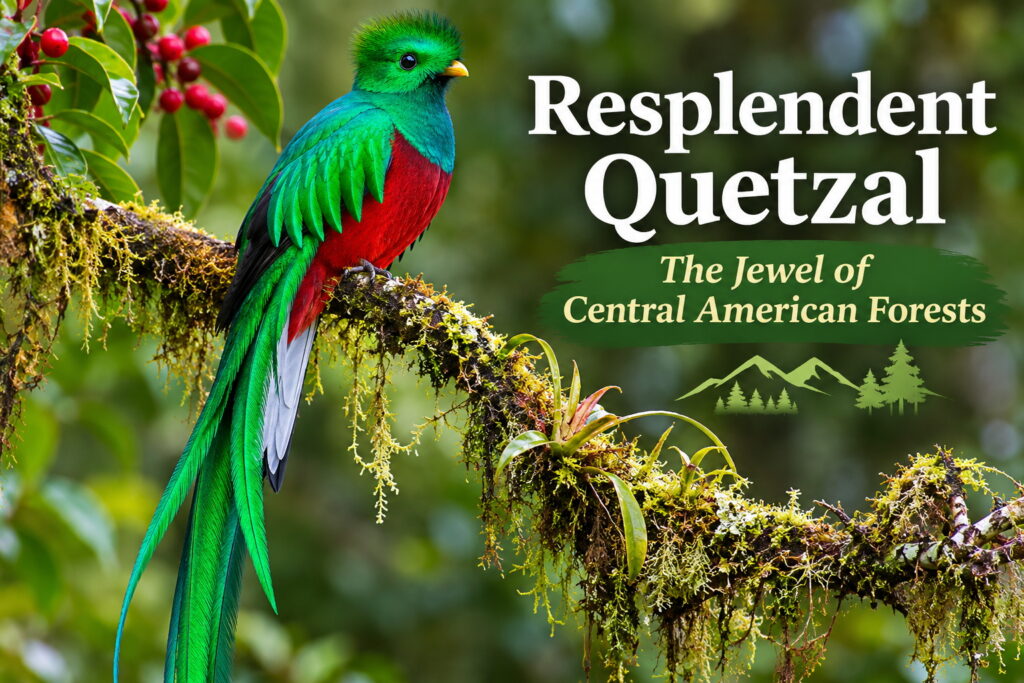
Deep within the mist-covered cloud forests of Central America lives one of the world’s most spectacular birds: the Resplendent Quetzal (Pharomachrus mocinno). With brilliant emerald-green feathers, a crimson breast, and extraordinary flowing tail plumes, this beautiful bird is a symbol of tropical biodiversity.


Quick Facts About the Resplendent Quetzal
- Scientific name: Pharomachrus mocinno
- Family: Trogonidae
- Distribution: Southern Mexico to western Panama
- Habitat: Tropical montane and cloud forests
- Body length: Approximately 36–40 cm, excluding elongated male plumes
- Diet: Fruits, insects, and small vertebrates
- Conservation status: Near Threatened
- National significance: National bird of Guatemala
1. Extraordinary Beauty and Colorful Plumage
The Resplendent Quetzal is celebrated for its striking combination of iridescent green upperparts and bright red underparts. Although the plumage appears green, its structural coloration can produce shimmering blue and turquoise tones as lighting conditions change.
Adult males possess elongated upper tail-coverts that can approach one metre in length. These dramatic feathers are especially conspicuous during courtship and flight.
Females are less colorful, with shorter tail feathers and more subdued plumage. Their appearance provides effective camouflage among moss-covered branches and dense forest vegetation.


2. Where Does the Resplendent Quetzal Live?
The species inhabits the humid mountain forests of southern Mexico, Guatemala, Honduras, El Salvador, Nicaragua, Costa Rica, and western Panama.
Its preferred environments include mature cloud forests characterized by dense vegetation, abundant moisture, moss-covered trees, and epiphytic plants.
Quetzals often breed at higher elevations but may move downslope during other seasons in response to changing fruit availability. Protecting connected habitats at different elevations is therefore essential for their survival.
3. A Diet That Helps Forests Grow
Resplendent Quetzals are primarily fruit-eating birds, although insects and small vertebrates also form part of their diet.
Wild avocados and other fruits from the laurel family are particularly important food sources. The birds can swallow fruits whole and later regurgitate their seeds in different locations.
By distributing seeds throughout the forest, quetzals contribute to the regeneration of trees and the long-term health of tropical ecosystems.
4. Breeding and Nesting Behavior
During the breeding season, male quetzals perform courtship displays that highlight their magnificent plumage and long flowing feathers.
Pairs typically nest in cavities in decaying trees or softened wood. Both parents participate in caring for the eggs and feeding the developing chicks.
The young birds remain dependent on parental care until they are sufficiently developed to leave the nest.


5. The Quetzal’s Importance in Ancient Civilizations
The Resplendent Quetzal occupies a special place in the cultural history of Mesoamerica.
Its feathers were highly prized by ancient Maya and Aztec societies and appeared in ceremonial decorations and symbols of power.
Today, the quetzal remains one of Guatemala’s most recognizable national symbols. The country’s currency is also named the quetzal, reflecting the bird’s enduring cultural significance.
6. Why Is the Resplendent Quetzal Threatened?
Despite its spectacular appearance, the Resplendent Quetzal faces growing environmental pressures.
Deforestation, agricultural expansion, habitat fragmentation, and climate-related changes threaten the mountain forests on which it depends.
The species is classified as Near Threatened on the IUCN Red List, and its population trend is decreasing.
Conservation efforts focus on protecting mature cloud forests, restoring degraded habitats, maintaining ecological corridors, and supporting responsible wildlife tourism.
7. Best Places to See a Resplendent Quetzal
Birdwatchers searching for this remarkable species often visit protected highland forests in Central America.
- Monteverde, Costa Rica: Famous for its cloud-forest ecosystems and birdwatching opportunities.
- Los Quetzales National Park, Costa Rica: A high-elevation protected area associated with quetzal habitat.
- Biotopo del Quetzal, Guatemala: A protected reserve dedicated to conserving cloud-forest wildlife.
- Highland forests of western Panama: Important habitats for the species.
Observation is never guaranteed. Visiting with experienced local guides, keeping a respectful distance, and avoiding disturbance near nests can improve the wildlife-watching experience while protecting the birds.
8. Fascinating Facts About the Resplendent Quetzal
- Its green plumage can appear blue or turquoise under different lighting conditions.
- The male’s longest flowing feathers are elongated upper tail-coverts.
- It belongs to the trogon family, a group of colorful forest birds.
- It is an important seed disperser for wild avocado relatives.
- It may migrate between different forest elevations during the year.
- Its name is shared with Guatemala’s national currency.
Conclusion
The Resplendent Quetzal is more than one of the world’s most beautiful birds. It is an important seed disperser, a cultural treasure, and a living symbol of Central America’s extraordinary cloud forests.
Protecting the quetzal means preserving the rich forest ecosystems that support countless other species. Its continued survival reminds us that biodiversity, natural beauty, and ecological balance are deeply connected.