


Views: 7
Secretary Bird: Africa’s Remarkable Terrestrial Hunter
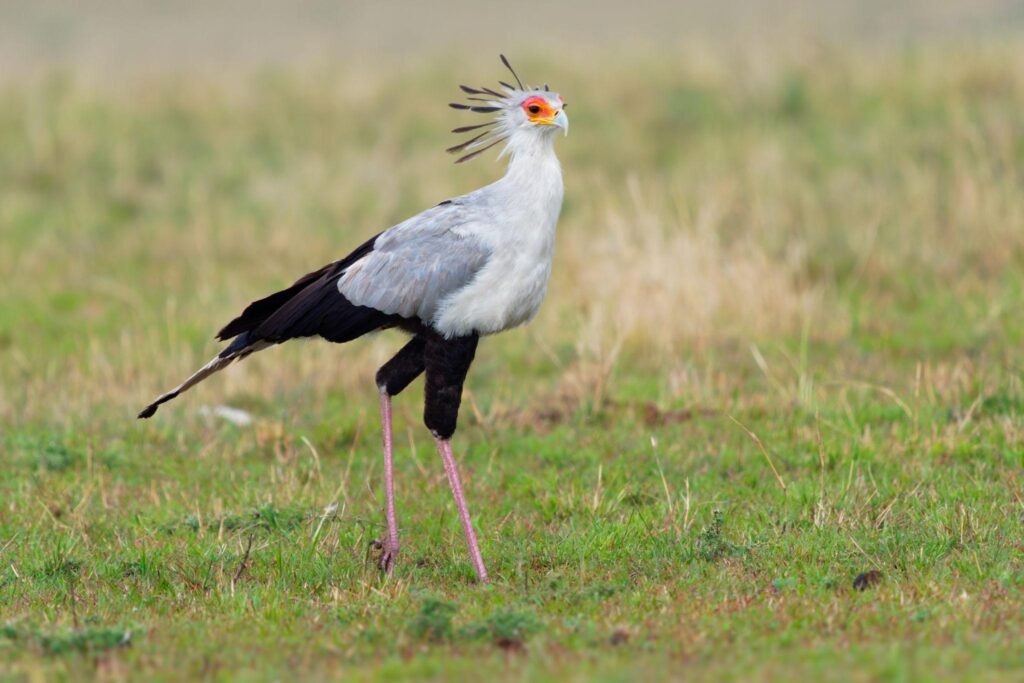
Secretary bird strolls though grass in the Kalahari looking for prey
8
The Secretary Bird (Sagittarius serpentarius) is one of Africa’s most extraordinary birds of prey. Unlike eagles and hawks that primarily hunt from the air, this remarkable raptor spends much of its day walking across open grasslands, searching for insects, reptiles, rodents, and snakes.
With its long legs, elegant black crest, powerful feet, and striking appearance, the Secretary Bird is a remarkable example of adaptation to terrestrial hunting.
1. Quick Facts
| Feature | Details |
|---|---|
| Scientific name | Sagittarius serpentarius |
| Family | Sagittariidae |
| Distribution | Sub-Saharan Africa |
| Habitat | Grasslands, savannas, open plains |
| Height | Approximately 1.25–1.5 metres |
| Wingspan | Approximately 2.1 metres |
| Weight | Approximately 2.3–4.3 kg |
| Diet | Insects, reptiles, rodents, snakes, small animals |
| Hunting style | Walking, stamping and kicking |
| Conservation status | Endangered (global IUCN assessment) |
BirdLife DataZone+2
2. What Makes the Secretary Bird Unique?
The Secretary Bird combines features that are rarely seen together in birds of prey.
Its head resembles that of an eagle, with a sharp hooked beak and keen eyesight. Its exceptionally long legs, however, are better suited for walking and striking prey than grasping animals in flight.
Its distinctive appearance includes a grey body, black flight feathers, a dramatic black crest, and orange-red bare facial skin.
Despite spending most of its hunting time on foot, the Secretary Bird is a capable flier and uses flight to reach nesting sites and perform aerial courtship displays.
3. A Powerful Ground Hunter
武器は「強力な蹴り」、草原の猛禽類ヘビクイワシの不思議な生態 | Forbes JAPAN 公式サイト(フォーブス ジャパン)
Secretary bird (Sagittarius Serpentarius) close up, Africa
Birds Tales – Fascinating Bird Stories & Wildlife Adventures
12
One of the Secretary Bird’s most fascinating abilities is its method of capturing prey.
Instead of relying on talons to seize animals, it often delivers powerful, accurately aimed downward strikes with its feet.
Its hunting strategy typically involves:
- Walking through open grassland while scanning for movement.
- Disturbing insects and other small animals hidden in vegetation.
- Approaching or pursuing detected prey.
- Delivering rapid foot strikes to incapacitate dangerous or fast-moving animals.
- Swallowing suitably sized prey, often whole.
Although famous for killing snakes, Secretary Birds consume a broad range of prey, and insects may form a substantial portion of their diet.BirdLife DataZone+1
4. Habitat and Distribution
Secretary Birds inhabit large areas of sub-Saharan Africa, including eastern and southern African grasslands and savannas.
They prefer landscapes with short or moderately open vegetation where they can walk freely and detect prey. Scattered trees provide important nesting and roosting sites.
Individual birds can travel considerable distances while foraging, with some studies reporting average daily movements of roughly 20–30 kilometres. BirdLife DataZone+1
5. Breeding and Family Life
Secretary Birds often form long-term breeding pairs.
They construct large platform nests using sticks, typically high in acacia or other suitable trees. A female generally lays two or three eggs, although not all chicks necessarily survive.
Both parents participate in caring for the young, providing food until the chicks become independent.
Their nesting success depends on habitat quality, prey availability, and suitable environmental conditions.
6. Conservation: A Threatened African Icon
Endangered
Global IUCN Red List assessment
Despite its widespread distribution, the Secretary Bird faces serious conservation challenges.
Major threats include habitat conversion for agriculture and urban development, degradation of grasslands through intensive grazing, disturbance of nesting sites, and persecution or capture.
BirdLife International estimates 6,700–67,000 mature individuals, with the population declining. This wide estimate reflects substantial uncertainty rather than a precise count. BirdLife DataZone+1
Protecting extensive open grasslands, maintaining safe nesting habitats, and improving monitoring are important for the species’ long-term survival.
7. Fascinating Secretary Bird Facts
- The Secretary Bird is the only living member of the family Sagittariidae.
- Its characteristic black crest gives it a striking, instantly recognizable silhouette.
- Unlike many other raptors, it searches for most of its food on foot.
- Its strong legs can deliver powerful strikes against snakes and other prey.
- It builds nests in trees even though most hunting takes place on the ground.
- It is a significant bird of prey in African grassland ecosystems.
Conclusion
The Secretary Bird is an exceptional example of evolutionary specialization. Its long legs, powerful kicking ability, impressive wings, and distinctive appearance make it one of Africa’s most recognizable raptors.
Protecting this species means protecting the open savanna and grassland ecosystems that support it.
SEO Package — Bin3aiah Birds
| SEO Element | Recommended Content |
|---|---|
| SEO title | Secretary Bird: Africa’s Remarkable Terrestrial Hunter |
| Slug | secretary-bird-african-terrestrial-hunter |
| Focus keyphrase | Secretary Bird |
| Secondary keyphrases | Secretary Bird facts, African birds of prey, Secretary Bird hunting, Sagittarius serpentarius |
| Category | Birds of Prey |
| Image ALT text | Secretary Bird walking through African savanna grassland searching for prey |
Meta description:
Discover the Secretary Bird, Africa’s remarkable ground-hunting raptor. Explore its powerful kicks, diet, habitat, behavior, and conservation status.
WordPress tags: Secretary Bird, Sagittarius serpentarius, African Birds, Birds of Prey, Raptors, African Wildlife, Savanna Birds, Snake-Hunting Birds, Bird Conservation, Wildlife Facts, Terrestrial Hunters, Grassland Wildlife
Suggested internal link: Bin3aiah Birds
External reference: BirdLife International — Secretarybird species factsheet