


Views: 10
Arctic Tern: The Bird of Extraordinary Migrations
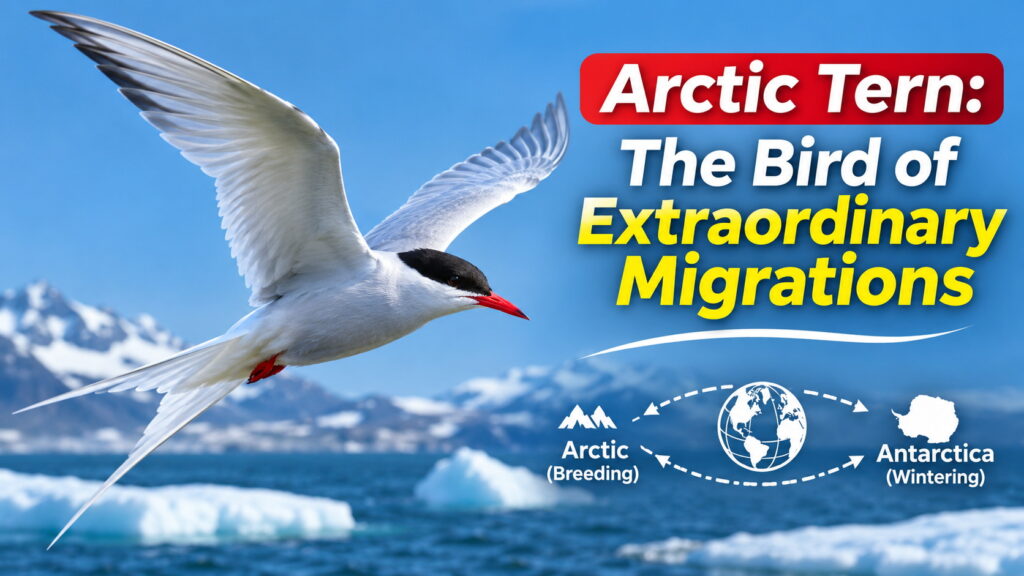
The Arctic Tern (Sterna paradisaea) is one of the world’s most extraordinary migratory birds. Despite its small size, this remarkable seabird travels between the Arctic and Antarctic regions every year, completing one of the longest annual migrations recorded in the animal kingdom.


Some Arctic Terns travel more than 80,000 kilometers (50,000 miles) annually, depending on their migration routes. Their journeys take them across vast oceans and through changing weather conditions, demonstrating remarkable endurance and navigation abilities.
By migrating between the Northern and Southern Hemispheres, these birds experience two summers each year and enjoy exceptionally long periods of daylight.
Quick Facts About the Arctic Tern
| Feature | Details |
|---|---|
| Scientific Name | Sterna paradisaea |
| Family | Laridae |
| Body Length | Approximately 33–35 cm |
| Wingspan | Approximately 75–85 cm |
| Weight | Approximately 95–125 grams |
| Diet | Small fish, crustaceans and insects |
| Breeding Areas | Arctic and northern temperate coastal regions |
| Wintering Areas | Southern Ocean near Antarctica |
| Lifespan | Can exceed 30 years |
| Conservation Status | Least Concern globally |
1. The Longest Annual Migration
Each year, Arctic Terns undertake an extraordinary journey from their northern breeding grounds toward Antarctic waters. When the southern summer approaches its end, they begin their return journey north.
Unlike birds that follow relatively direct migration routes, Arctic Terns frequently travel along curved oceanic pathways. These routes help them benefit from favorable winds and productive feeding areas.
Tracking studies using miniature geolocation devices have shown that some Arctic Terns cover more than 80,000 kilometers during a complete annual migration cycle.
Their journeys may involve crossing the Atlantic Ocean, traveling through tropical waters and eventually reaching the Southern Ocean.
Why Do Arctic Terns Travel So Far?
The main advantage is access to seasonal food resources and productive marine environments. By following summer conditions in both hemispheres, Arctic Terns can take advantage of long daylight hours and favorable feeding opportunities.
Rather than remaining in one region throughout the year, they follow seasonal changes across much of the planet.
2. How Arctic Terns Navigate Across Oceans


One of the most fascinating mysteries surrounding Arctic Terns is their ability to navigate over enormous stretches of open ocean.
Scientists believe these birds may use a combination of environmental information to orient themselves during migration.
- Solar position: The sun may provide useful directional information.
- Earth’s magnetic field: Magnetic cues may contribute to long-distance orientation.
- Wind patterns: Favorable winds help make extensive journeys more efficient.
- Experience: Older birds may benefit from knowledge gained during previous migrations.
- Environmental conditions: Oceanic and atmospheric cues may help shape routes.
Although researchers continue to investigate the exact mechanisms involved, the Arctic Tern’s navigation abilities remain among the most impressive in the bird world.
3. Physical Adaptations for Extraordinary Flight
Arctic Terns possess several physical characteristics that make them highly efficient long-distance flyers.
Long, Narrow Wings
Their pointed wings support efficient flight and allow them to take advantage of wind conditions over the ocean.
Lightweight Bodies
Despite having a wingspan approaching 85 centimeters, an Arctic Tern typically weighs only around 100 grams. This relatively low body mass helps reduce the energy required for flight.
Deeply Forked Tails
The bird’s distinctive forked tail helps with maneuverability and control, especially when flying above water or searching for prey.
Efficient Flight Behavior
Arctic Terns combine active wingbeats with gliding and wind-assisted travel. By responding to atmospheric conditions, they can reduce the energetic demands of migration.
4. Feeding Habits and Hunting Techniques

Arctic Terns primarily feed on small fish and other marine organisms found close to the water’s surface.
Their diet may include:
- Sand eels and other small fish
- Young herring and similar schooling fish
- Small crustaceans
- Marine invertebrates
- Insects, particularly near breeding areas
These agile birds often hover briefly above the ocean before plunging toward the water to catch prey.
Unlike deeper-diving seabirds, Arctic Terns generally capture food near the surface using shallow plunge-dives and surface-feeding techniques.
Access to reliable food supplies is especially important before migration and during the breeding season, when adults must also feed their growing chicks.
5. Breeding, Nesting and Parenting

Arctic Terns return to northern coastal environments during the breeding season. Their nesting habitats include rocky islands, beaches, coastal tundra and sparsely vegetated ground.
They typically nest in colonies, although colony sizes vary considerably depending on habitat and available resources.
Simple Ground Nests
Rather than building elaborate nests, Arctic Terns create shallow depressions in the ground. These may contain small stones, shells or vegetation.
Females generally lay one to three eggs, most commonly one or two.
Shared Parental Responsibilities
Both parents take part in incubating the eggs and caring for the young. After hatching, chicks depend on adults for food and protection while they develop.
Protective Parents
Arctic Terns are famous for their aggressive nest defense. Adults may dive repeatedly toward gulls, mammals or even humans that approach their nesting territories.
These defensive behaviors help protect vulnerable eggs and chicks in exposed coastal environments.
6. Courtship and Social Behavior

Arctic Terns display interesting social behaviors during the breeding season, including courtship flights, vocal communication and interactions between potential mates.
One characteristic behavior involves a bird carrying a fish while engaging in courtship activities. Food offerings can play an important role in pair formation and strengthening social bonds.
Arctic Terns communicate using a variety of sharp calls, particularly around nesting colonies.
Their colonies can become noisy and highly active as adults defend territories, locate partners and deliver food to their young.
7. A Lifetime of Remarkable Travel
Arctic Terns are relatively long-lived birds, with some individuals surviving for more than three decades.
When their annual migrations are considered over an entire lifetime, the total distance traveled can exceed one million kilometers.
For exceptionally long-lived individuals that complete extensive migrations year after year, the cumulative distance may be equivalent to several journeys between Earth and the Moon.
This remarkable endurance makes the Arctic Tern one of the most impressive examples of long-distance movement in the natural world.
8. Threats and Conservation Challenges
Although Arctic Terns are globally classified as Least Concern, populations in certain regions face significant environmental pressures.
Climate Change
Changes in ocean temperatures and sea-ice patterns can influence the availability and distribution of fish and other prey.
Changes in Food Supply
Declines in suitable prey can reduce breeding success and make it more difficult for adults to raise healthy chicks.
Disturbance at Nesting Colonies
Human activity near nesting habitats can disrupt breeding birds and leave eggs or chicks exposed to danger.
Predation and Invasive Species
Introduced predators, including certain mammals, can threaten vulnerable ground-nesting colonies.
Protecting nesting areas, monitoring seabird populations and maintaining healthy marine ecosystems are important conservation priorities.
9. Amazing Arctic Tern Facts
- Arctic Terns migrate between northern breeding areas and Antarctic waters.
- Some individuals travel more than 80,000 kilometers in a year.
- They experience two summer seasons annually.
- Their long wings and lightweight bodies support efficient flight.
- They primarily hunt small fish near the ocean surface.
- Both parents help care for their chicks.
- Adults aggressively defend nesting territories.
- Some individuals live for more than 30 years.
- Their lifetime travel distance can exceed one million kilometers.
- The species connects ecosystems across both hemispheres.
Frequently Asked Questions
How far does an Arctic Tern migrate?
Many Arctic Terns travel tens of thousands of kilometers annually. Some tracked individuals complete migration journeys exceeding 80,000 kilometers.
Where do Arctic Terns spend the winter?
They spend the northern winter primarily in productive waters of the Southern Ocean near Antarctica.
Why do Arctic Terns migrate so far?
Their migration allows them to follow seasonal conditions and access food resources in both hemispheres.
How long do Arctic Terns live?
Arctic Terns can live for more than 30 years, although survival varies among individuals and populations.
Do Arctic Terns fly nonstop to Antarctica?
No. Their migration includes periods of feeding and movement through different oceanic regions. They do not complete the entire journey in one uninterrupted flight.
Conclusion
The Arctic Tern is a remarkable example of endurance, navigation and adaptation. Its extraordinary journeys between the Arctic and Antarctic demonstrate how animals can use seasonal changes and global environmental patterns to survive.
From its elegant flight and sophisticated migration routes to its protective parenting behavior, this small seabird continues to fascinate scientists and nature enthusiasts.
Protecting the Arctic Tern also means protecting the interconnected marine habitats that support wildlife across the world’s oceans.
References and Further Reading
- Cornell Lab of Ornithology – Arctic Tern
- National Audubon Society – Arctic Tern
- Scientific Research – Tracking Arctic Tern Migration
- Wikimedia Commons – Arctic Tern Photographs
Image Credits and Licenses
The photographs in this article come from Wikimedia Commons. Please retain the photographer credits and respect each image’s license conditions, including attribution and share-alike requirements where applicable.


