
Views: 1
Atlantic Gannet: The Seabird That Dives for Fish
The Atlantic gannet, also known as the Northern Gannet (Morus bassanus), is one of the most remarkable seabirds of the North Atlantic Ocean. Famous for its spectacular high-speed dives, this powerful marine hunter combines exceptional flying ability with specialized adaptations for catching fish underwater.

Atlantic Gannet: Quick Facts
| Scientific Name | Morus bassanus |
|---|---|
| Family | Sulidae |
| Common Name | Northern Gannet |
| Habitat | North Atlantic Ocean |
| Wingspan | Approximately 170–192 cm |
| Diet | Fish and occasional squid |
| Diving Speed | Can exceed 100 km/h |
| Reproduction | Usually one egg per breeding attempt |
How Atlantic Gannets Dive for Fish
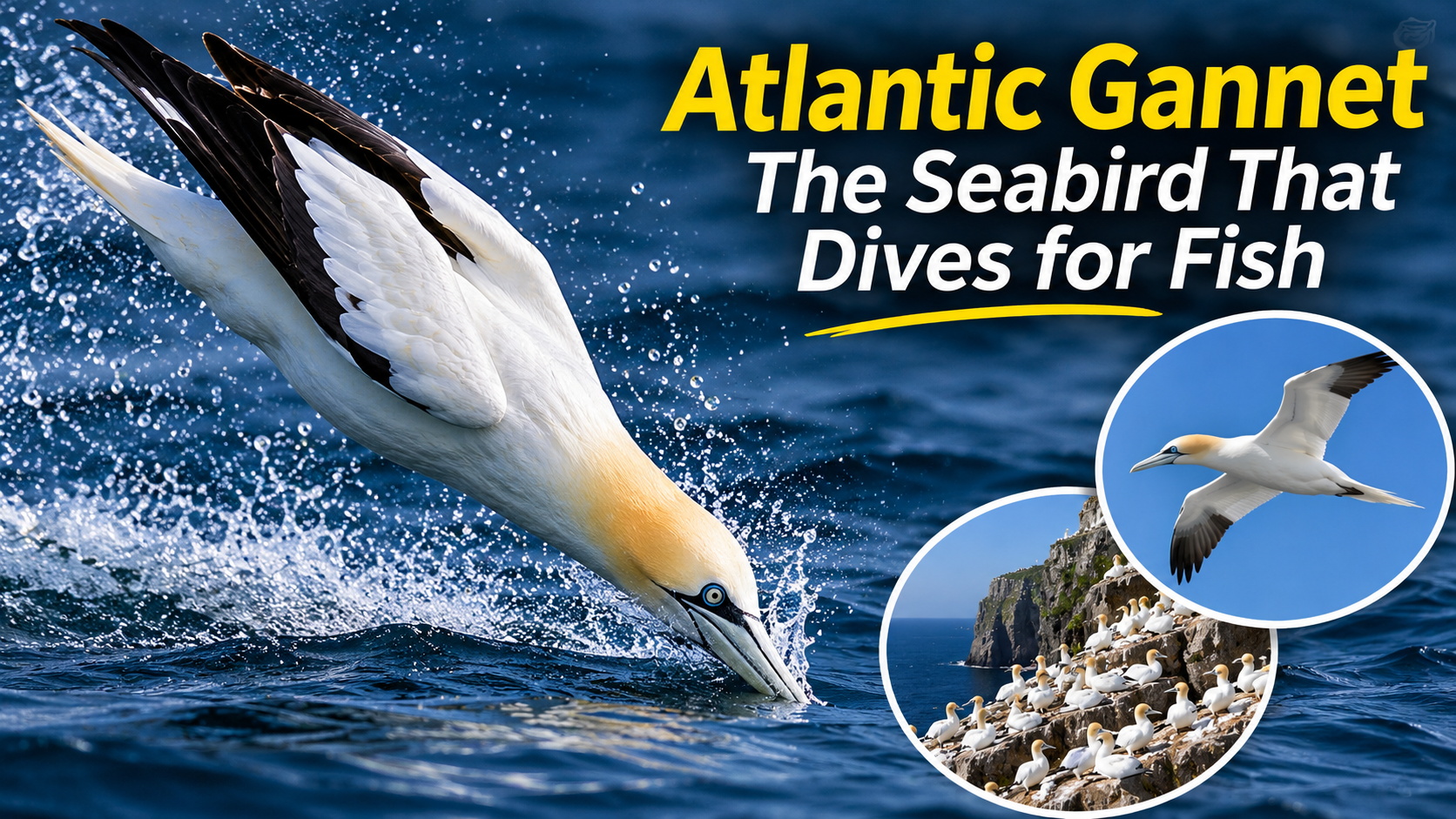
The Atlantic gannet is especially famous for a hunting technique called plunge-diving. Unlike seabirds that catch prey only at the water’s surface, gannets launch themselves from the air and penetrate the water to capture fish.
While flying over the ocean, a gannet searches for schools of fish swimming beneath the surface. Once it identifies a promising target, it changes direction and begins a rapid descent.
Immediately before entering the water, it folds its wings backward and extends its pointed bill forward. This creates a streamlined body shape that reduces resistance during impact.

The Four Stages of a Gannet Dive
- Searching: The bird surveys the ocean from above, using its sharp eyesight to locate prey.
- Descending: It begins a controlled, high-speed dive toward the fish.
- Water Entry: The bird folds its wings and enters the water bill-first.
- Capturing Prey: It catches fish underwater, sometimes swimming farther using its wings and feet.
Gannets can enter the sea at speeds exceeding 100 km/h under favorable conditions. Although many dives are shallower, they can reach depths of approximately 20 metres or more.
Special Adaptations for High-Speed Diving
Plunging into water at high speed produces considerable physical forces. Northern gannets have several adaptations that make this remarkable hunting strategy possible.
1. Streamlined Body
The gannet has a long neck, pointed bill and aerodynamic body. These features help it move efficiently through the air and enter the water with reduced resistance.
2. Protective Air Sacs
Air sacs beneath the skin help cushion the impact when the bird hits the water. This protective system is an important adaptation for repeated plunge-diving.
3. Specialized Nostrils
Unlike birds with prominent external nostril openings on their bills, gannets have adaptations that reduce water entry during diving.
4. Powerful Wings
Long, narrow wings support efficient flight over the ocean. After entering the sea, gannets can also use wing movements to pursue prey underwater.
5. Excellent Eyesight
Their vision helps them detect fish and identify suitable diving locations while flying above the sea.
Where Do Atlantic Gannets Live?
Northern gannets inhabit the North Atlantic Ocean and breed on rocky islands, isolated sea stacks and coastal cliffs.
Important breeding regions include:
- Scotland and other parts of the United Kingdom
- Ireland
- Iceland
- Norway
- Eastern Canada
- Other North Atlantic islands and coastal regions
Some of the most famous breeding colonies occur at Bass Rock in Scotland, Bonaventure Island in Canada and Little Skellig in Ireland.

Breeding and Family Life
Atlantic gannets are highly social birds during the breeding season, gathering in large colonies that may contain thousands of nesting pairs.
Many breeding pairs reunite at established nesting locations and perform elaborate greeting displays involving bill movements and neck stretching.
The female normally lays a single egg. Both parents participate in incubation and later care for the chick.
Parents feed their young by regurgitating fish. The chick develops rapidly and eventually leaves the breeding colony to begin life at sea.
Young gannets initially have dark plumage with pale markings. As they mature, their feathers become progressively lighter. Adults have predominantly white bodies, black wingtips and pale yellowish heads.
What Do Atlantic Gannets Eat?
The Northern Gannet is primarily a fish-eating seabird. Its diet depends on the season, region and availability of prey.
Common food sources include:
- Herring
- Mackerel
- Sand eels
- Sprats
- Sardines
- Occasionally squid
Gannets often gather where fish are abundant, sometimes feeding alongside other seabirds and marine predators.
Their ability to travel long distances helps them locate feeding grounds across large ocean areas.
Migration and Life at Sea
Outside the breeding season, many Northern Gannets disperse across the Atlantic Ocean, sometimes traveling considerable distances from their nesting colonies.
Young birds may travel farther south than experienced adults, reaching waters off western Europe and northwest Africa.
Much of the gannet’s life is spent over open water, where its long wings and efficient flight allow it to search for fish across extensive marine habitats.
Threats and Conservation
Despite their impressive hunting abilities, Northern Gannets face several environmental challenges.
- Fishing bycatch: Birds can become accidentally caught in fishing gear.
- Marine pollution: Plastics and abandoned fishing materials may affect seabirds and nesting areas.
- Food availability: Changes in fish populations can influence feeding success.
- Climate change: Changing ocean temperatures can alter prey distribution.
- Avian influenza: Disease outbreaks have caused serious mortality in some breeding colonies.
Protecting breeding colonies, maintaining healthy marine ecosystems and reducing fishing-related threats are important for the long-term future of these seabirds.
Interesting Facts About Atlantic Gannets
- Northern gannets are among the largest seabirds of the North Atlantic.
- Their wingspan can approach two metres.
- They can enter the water at speeds exceeding 100 km/h.
- They usually raise only one chick during a breeding season.
- They frequently return to established breeding colonies.
- Their distinctive adult plumage develops gradually over several years.
- They can travel substantial distances across the ocean in search of food.
Why the Atlantic Gannet Is One of the Ocean’s Most Remarkable Birds
The Atlantic gannet demonstrates an extraordinary combination of aerial efficiency, underwater hunting ability and specialized physical adaptations.
From its dramatic headfirst dives to its enormous breeding colonies, this seabird is a fascinating example of how wildlife adapts to life in challenging marine environments.
Understanding the Northern Gannet also highlights the importance of healthy oceans, abundant fish populations and the protection of seabird breeding habitats.
Sources and Further Reading
- RSPB – Gannet Species Guide
- Animal Diversity Web – Morus bassanus
- Wikimedia Commons – Northern Gannet Photographs
Explore more wildlife articles and bird profiles at Bin3aiah Birds.