

Views: 0
Osprey: The Fish-Hunting Raptor
BIN3AIAH BIRDS | WILDLIFE & BIRDS OF PREY


9
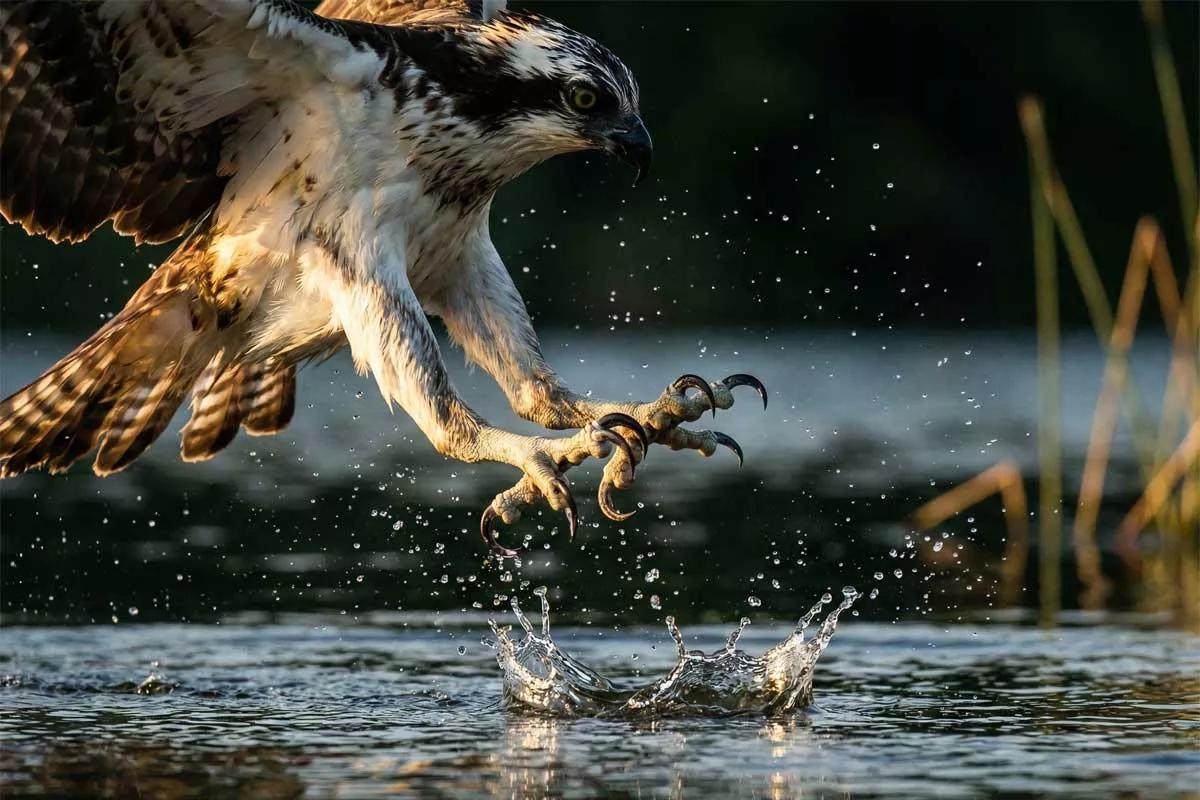
The osprey (Pandion haliaetus) is one of nature’s most extraordinary aerial hunters. Also known as the fish hawk, this powerful bird of prey has evolved remarkable adaptations that allow it to locate fish from the sky, plunge toward the water, and lift slippery prey into the air using its razor-sharp talons.
Unlike most other raptors, the osprey depends almost entirely on fish. Its unusual feet, exceptional eyesight, and spectacular diving technique make it one of the world’s most specialized fishing birds.
Osprey at a glance
Scientific name
Pandion haliaetus
Family
Pandionidae
Length
54–58 cm
Wingspan
150–180 cm
Weight
1.4–2.0 kg
Diet
Almost entirely fish
Distribution
All continents except Antarctica
Conservation status
Least Concern
Measurements and identification: Cornell Lab of Ornithology. Conservation and distribution: Audubon.
All About Birds
+2
How ospreys hunt fish
The osprey’s hunting method is a remarkable combination of precision, speed, and aerodynamic control.

1. Searching from above
The osprey patrols lakes, rivers, estuaries, and coastlines, scanning the water for fish swimming near the surface.
2. The dramatic dive
After spotting its target, the bird may briefly hover before descending feet-first, extending its talons toward the water.

3. Catching the fish
Sharp curved claws and rough gripping pads help prevent slippery prey from escaping.

4. Carrying its catch
Once airborne, the osprey often turns the fish head-first to reduce air resistance before flying to a perch or its nest.
Studies summarized by Cornell found that ospreys can succeed in at least one-quarter of their dives, with some studies reporting success rates as high as 70%.
All About Birds
+1
Special adaptations for fishing
The osprey possesses several physical advantages that distinguish it from other birds of prey.
- Reversible outer toe: Allows two toes to face forward and two backward for a powerful grip.
- Spiny foot pads: Help hold slippery fish securely.
- Protective third eyelid: Helps protect the eyes during a dive.
- Closable nostrils: Help prevent water from entering the nostrils.
- Long, narrow wings: Enable efficient flight over water.
These adaptations are part of what makes the osprey an exceptional specialist rather than a generalist hunter.
All About Birds
+1
Habitat and global distribution


9
Ospreys inhabit a remarkable variety of aquatic environments, including freshwater lakes, rivers, coastal lagoons, reservoirs, mangrove systems, and saltwater estuaries.
They occur across much of the world, with many northern populations migrating long distances to warmer regions for winter. In contrast, some tropical and subtropical populations remain in the same region throughout the year.
Their dependence on accessible fish means that healthy aquatic habitats are essential to their survival.
All About Birds
+1
Nesting and raising young
Ospreys construct large nests made mostly of sticks, often on high trees, poles, cliffs, or artificial nesting platforms. A pair may reuse the same nest and add more material across successive breeding seasons.
A typical clutch contains one to four eggs. Incubation lasts approximately 36–42 days, and young birds usually remain in the nest for another 50–55 days before fledging.
The older chicks frequently hatch before their siblings, creating differences in size and competitive advantage, especially when food is limited.
All About Birds
Conservation: A remarkable recovery
Historically, osprey populations in some regions suffered severely from pesticide contamination, particularly DDT, which contributed to reproductive failures through eggshell thinning.
Following pesticide restrictions, habitat protection, and the installation of artificial nesting platforms, populations in several regions recovered significantly.
Today, the species is assessed as Least Concern globally, although local populations still face risks from habitat degradation, fishing-line entanglement, disturbance, and pollution.
All About Birds
+1
Fascinating osprey facts
- Ospreys are found on every continent except Antarctica.
- They can capture fish with their feet while partially submerging in water.
- Their outer toes can rotate backward for a secure grip.
- They frequently transport fish head-first in flight.
- Their large stick nests can be reused and enlarged for many years.
- Migrating ospreys generally travel individually rather than in large flocks.
- The oldest recorded wild osprey in Cornell’s records lived at least 25 years and two months.
All About Birds
+2
Conclusion
The osprey illustrates how evolution can shape an animal into a highly specialized hunter. From its extraordinary fishing dives to its uniquely adapted feet, almost every aspect of its anatomy supports a life centered around water.
Watching an osprey emerge from a lake carrying a freshly caught fish is one of the most memorable experiences birdwatching can offer.
Publisher package — Bin3aiah Birds
Content preparation
Article ready
| Website | birds.bin3aiah.net |
| Proposed ID | BIRD-OSPREY-001 |
| SEO title | Osprey: The Fish-Hunting Raptor |
| Slug | osprey-fish-hunting-raptor |
| Focus keyword | Osprey bird |
| Categories | Birds of Prey, Wildlife |
SEO meta description
Discover how the osprey hunts fish using powerful talons, precision dives, and special adaptations. Explore its habitat, nesting, and conservation.
Copy description
Photo and video resources
For the article’s media gallery, these sources provide real osprey footage and photographs rather than AI-generated wildlife.

Osprey photo gallery
Browse Wikimedia Commons images — hundreds of photographs for selecting a featured image and gallery.

Fishing and prey photographs
Browse osprey hunting media — photographs and video files featuring successful catches.

Identification and behavioral footage
Cornell Lab photo and video guide — scientifically curated identification and behavior references.
Media publishing note: Aim for at least 10 appropriately licensed photographs and 3 relevant videos. The linked collections provide candidates, but individual image licenses, credits, video embedding permissions, and featured-image rights still need verification before publishing.
Status: Article and SEO copy prepared. Media selection is preliminary, duplicate checking against the live website is not completed, and the article has not been published.