
Views: 10
Bird-of-Paradise: Courtship Displays in the Rainforest
Deep within the tropical rainforests of New Guinea and surrounding regions, birds-of-paradise perform some of the most extraordinary courtship displays in the animal kingdom. With shimmering feathers, spectacular body transformations, rhythmic dances, and unusual calls, these birds turn the forest into a remarkable natural theater.

What Are Birds-of-Paradise?
Birds-of-paradise belong to the family Paradisaeidae, a group containing approximately 40 species, depending on taxonomic classification. Most occur in New Guinea, with additional species inhabiting nearby Indonesian islands and parts of Australia.
While some species appear relatively modest, others possess dramatically elongated plumes, iridescent throat feathers, ornamental head wires, and specialized feather capes.
In many species, males and females look strikingly different. Males often display brilliant colors and extravagant decorations, while females commonly have brown or subdued plumage that helps them remain inconspicuous while nesting.
Why Do Birds-of-Paradise Perform Courtship Dances?
Their elaborate performances are largely explained by sexual selection, an evolutionary process in which traits that improve mating success can become increasingly elaborate over generations.
Female birds-of-paradise evaluate potential partners through visual displays, vocalizations, movements, and sometimes very close physical inspection. A spectacular male may attract attention, but the female ultimately determines whether mating takes place.
Some males spend years practicing movements and observing experienced adults before achieving fully developed courtship performances.
1. Greater Superb Bird-of-Paradise: A Living Optical Illusion
The greater superb bird-of-paradise is famous for its dramatic physical transformation. During courtship, the male spreads a dark feather cape and displays brilliant blue-green breast feathers, creating the appearance of a striking geometric shape.

The male raises its cape, presents its breast shield, and performs rapid hopping movements around the female. The overall impression can resemble a floating dark face with luminous markings.
The closely related Vogelkop superb bird-of-paradise produces a different display shape and dance pattern, illustrating how even related birds can develop distinctive courtship rituals.
2. Western Parotia: The Rainforest Ballerina
The western parotia (Parotia sefilata) performs one of the most recognizable courtship dances among birds-of-paradise.
Before displaying, a male prepares a small court on the forest floor by removing leaves and other debris. Once a female approaches, he spreads his flank feathers into a skirt-like shape and begins a carefully coordinated dance.

The display includes upright postures, swift sideways steps, feather movements, and changes in body position. A female may watch from an elevated branch, observing the choreography from a particular angle.
This remarkable behavior demonstrates how a male’s movements and the female’s viewing position can work together to produce a highly specialized visual performance.
3. Magnificent Riflebird: Precision and Coordination
The magnificent riflebird (Ptiloris magnificus) uses dramatic wing movements during courtship. The male typically displays from a perch or vine, where he raises his rounded wings and moves them in a coordinated sequence.

The male fans one wing and then the other, shifts his head position, and uses careful footwork to remain directly in front of the female.
His dark plumage contrasts with iridescent feathers that can reflect brilliant colors under suitable lighting. Even small differences in timing and movement may influence how the performance appears to a watching female.
4. Greater Bird-of-Paradise: A Spectacular Group Display
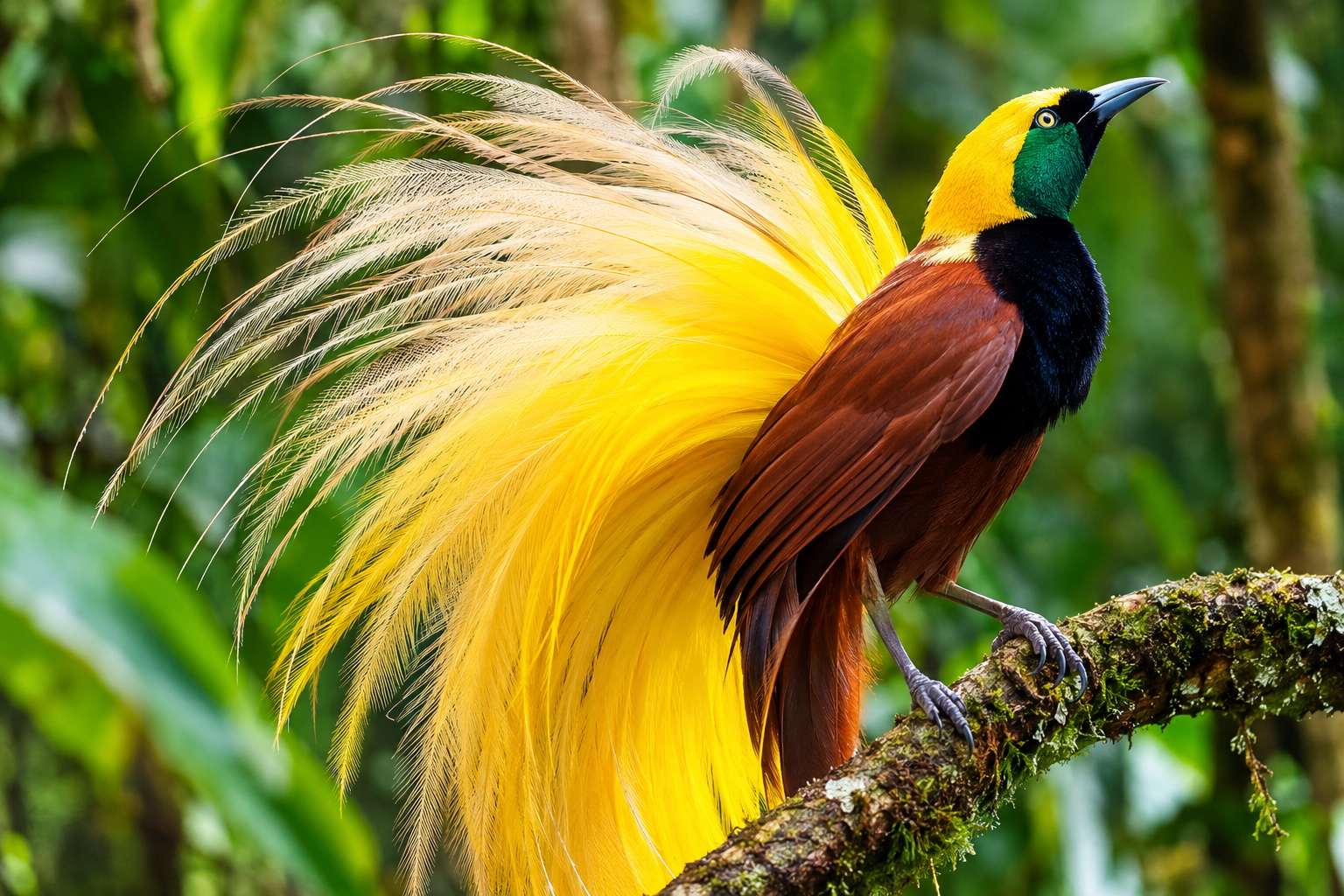
The greater bird-of-paradise (Paradisaea apoda) is particularly famous for its flowing golden-yellow plumes.
Males often gather at communal display sites known as leks. At these sites, several males compete for the attention of visiting females.

During their performances, males call loudly, move along branches, shake their feathers, and present their ornamental plumes. A female may approach closely to examine a male before deciding whether to mate.
Although males sometimes appear to display together, they are competing for mating opportunities rather than cooperating as partners.
How Do Female Birds Choose Their Partners?
Female choice is essential to understanding the extraordinary evolution of birds-of-paradise.
Depending on the species, females may respond to several characteristics:
- Plumage quality: The appearance, arrangement, and condition of decorative feathers.
- Dance accuracy: How effectively a male performs a coordinated sequence.
- Color and light: The visibility of reflective and iridescent feathers.
- Calls and sounds: Vocalizations and other sounds used during courtship.
- Display location: The suitability of a perch or cleared court for presenting the performance.
Not every display results in mating. Females frequently visit males without selecting them, and may return to display sites on other occasions.
The Science Behind Their Spectacular Feathers
Birds-of-paradise demonstrate fascinating relationships between feather structure, light, and color.
Some feathers contain microscopic structures that reflect specific wavelengths of light, creating vivid iridescent colors that can change with the viewing angle.
Other specialized feathers absorb much of the incoming light, creating unusually dark surfaces. These dark regions can make nearby bright feathers appear even more intense.
For certain species, the angle between the male, the female, and the source of light is an important part of the visual display.
Where Do Birds-of-Paradise Live?
Most birds-of-paradise inhabit the island of New Guinea, including its extensive lowland rainforests and mountainous forests. Others live on nearby islands or in northeastern Australia.
Their habitats include tropical forest canopies, humid mountain forests, and dense understory vegetation. Different species use different forest layers for feeding, shelter, and courtship.
These birds feed on a variety of foods, including fruits and arthropods. Some species also play important roles in forest ecosystems by dispersing seeds.
Threats and Conservation
Although not every bird-of-paradise species is currently threatened, forest loss and degradation can endanger populations by reducing feeding areas, nesting habitat, and traditional display sites.
Important conservation concerns include:
- Deforestation and habitat fragmentation.
- Unsustainable hunting or trapping in some regions.
- Road construction and land-use changes.
- Disturbance of breeding and courtship habitats.
- Climate-related changes to suitable forest environments.
Protecting intact rainforest ecosystems and supporting sustainable local conservation initiatives are important for maintaining healthy bird populations.
Five Fascinating Bird-of-Paradise Facts
- Birds-of-paradise are especially diverse in New Guinea.
- Some males transform their body outlines using specialized feather capes.
- Parotias perform carefully choreographed dances on cleared forest-floor courts.
- Young males may practice courtship behaviors for years before becoming successful adult performers.
- In many species, females provide most or all of the nesting and parental care.
Watch Birds-of-Paradise Courtship Displays
Photographs reveal their remarkable plumage, but video is particularly valuable for understanding how the dance, sounds, timing, and female response work together.
- Cornell Lab: Birds-of-Paradise Courtship Dances and Videos
- Cornell Lab: Female Inspection and Courtship Behavior
- PBS Nature: Birds of the Gods — Photos and Video Clips
Conclusion
Birds-of-paradise represent one of evolution’s most spectacular examples of courtship behavior. Their extraordinary feather structures, vivid colors, elaborate dances, and complex interactions with females reveal the powerful influence of sexual selection.
From the remarkable cape of the greater superb bird-of-paradise to the delicate ballerina dance of the western parotia, each species reveals a different solution to the challenge of attracting a mate.
Protecting the rainforests where these birds live will help preserve their unusual behaviors and the remarkable biodiversity of their natural habitats.