
Views: 7
Vermilion Flycatcher: The Brilliant Red Bird of the Americas
The Vermilion Flycatcher is one of the most visually striking small birds found in the Americas. With its dazzling scarlet-red feathers, dark wings, and lively movements, this fascinating bird is a favorite among birdwatchers and wildlife photographers.

This agile insect hunter inhabits open landscapes, desert scrublands, grasslands, and river corridors. Despite its small size, it is remarkably active, using quick aerial maneuvers to catch flying insects.
Quick Facts About the Vermilion Flycatcher
- Common name: Vermilion Flycatcher
- Scientific name: Pyrocephalus obscurus in classifications that recognize the split from Pyrocephalus rubinus
- Family: Tyrannidae (tyrant flycatchers)
- Size: Approximately 13–15 cm long
- Weight: Approximately 11–14 grams
- Diet: Primarily insects
- Habitat: Open woodland, grassland, scrubland, and riverside vegetation
- Distribution: Southwestern North America, Mexico, parts of Central America, and South America, depending on species classification
Appearance: A Brilliant Scarlet Bird
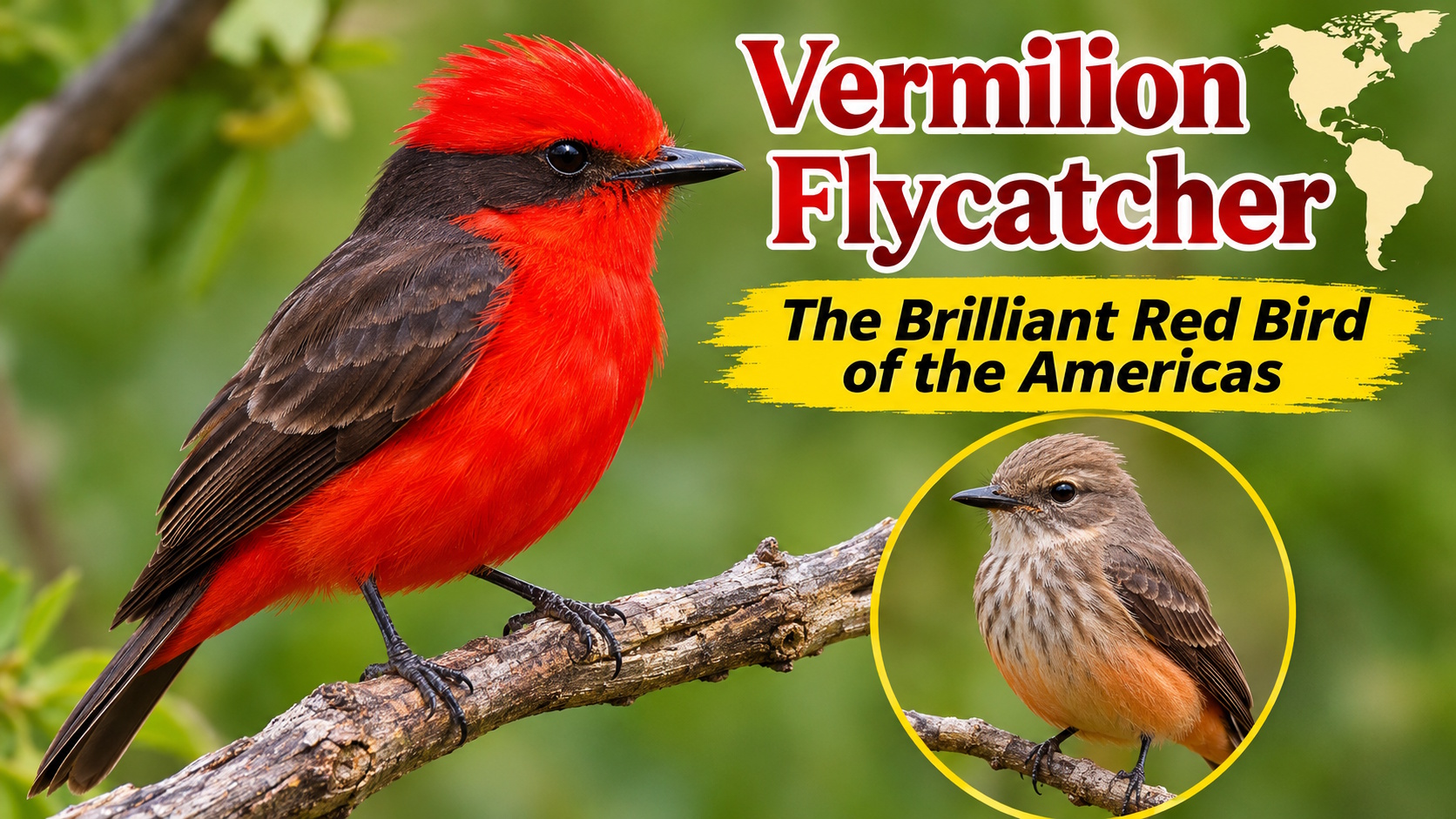
The adult male Vermilion Flycatcher stands out with a glowing red head, chest, and belly. A dark mask extends through the eyes, while its brown-black wings and tail create a striking contrast.

Females have a more subtle appearance, with grayish-brown upperparts, pale underparts, and streaking across the chest. Many also display soft peach or orange coloration on their lower bellies. Juvenile birds generally resemble the less colorful female.

Where Does the Vermilion Flycatcher Live?
Vermilion Flycatchers inhabit warm, open environments where they can easily spot and pursue insects. They frequently occur around streams, ponds, agricultural fields, scattered trees, and desert vegetation.
In the southwestern United States, these birds are especially associated with riparian habitats—green corridors beside rivers and streams. Populations farther south occupy a variety of tropical and subtropical open habitats.
Diet and Hunting Techniques
Vermilion Flycatchers are predominantly insectivorous. Their prey includes flies, beetles, grasshoppers, moths, and other small insects.
The bird often waits on an exposed branch, shrub, or fence. When it detects prey, it launches into the air, captures the insect with its bill, and returns to a perch. This hunting technique is known as aerial hawking.
They may also capture insects close to the ground or vegetation. Their fast reactions and maneuverability make them effective hunters despite their small size.
Courtship and Breeding Behavior
During the breeding season, males perform energetic display flights to attract females. A male may rise into the air while fluttering and vocalizing, showing off its colorful plumage.
The female usually constructs a compact cup-shaped nest from grasses, plant fibers, and other fine materials, often binding the structure with spider silk and decorating it with lichens.
A typical clutch contains two to four eggs. Incubation lasts roughly two weeks, and both parents may participate in caring for and feeding their chicks.
Behavior and Communication

Vermilion Flycatchers are often observed alone or in pairs. They frequently select visible perches that provide a clear view of their surroundings and hunting opportunities.
Males defend breeding territories and communicate through short calls and display songs. Their combination of bright coloring, exposed perching behavior, and aerial displays makes them relatively easy to observe in suitable habitats.
Interesting Facts About the Vermilion Flycatcher
- The male’s brilliant red coloration makes it one of the most recognizable flycatchers in the Americas.
- Males and females look so different that inexperienced observers may mistake them for separate species.
- These birds often return to favored perches after capturing insects.
- Their courtship flights combine wing movements, singing, and conspicuous aerial displays.
- The genus name Pyrocephalus refers to a flame-colored head.
- Scientific classifications vary, and some older field guides use Pyrocephalus rubinus for populations now assigned to Pyrocephalus obscurus.
Conservation and Environmental Threats
The Vermilion Flycatcher remains widespread across much of its range, but some regional populations have experienced declines.
Habitat loss, altered river systems, development, and the degradation of native streamside vegetation can reduce suitable nesting and feeding areas.
Protecting riparian ecosystems, maintaining native trees and shrubs, and conserving healthy insect populations are important steps toward supporting these beautiful birds.
Tips for Birdwatchers and Wildlife Photographers
Look for Vermilion Flycatchers on exposed branches, fence posts, and low shrubs in open landscapes. Early morning and late afternoon often provide attractive natural light for photography.
Use binoculars or a telephoto lens to observe from a comfortable distance. Avoid approaching active nests, disturbing nesting birds, or damaging sensitive riverside vegetation.
Conclusion
The Vermilion Flycatcher is a remarkable symbol of color, agility, and natural beauty. Its dazzling red feathers, skillful aerial hunting, and fascinating courtship behavior make it one of the most memorable birds of the Americas.
By appreciating and protecting the habitats that support this species, we can help ensure that future generations continue to enjoy its spectacular presence in the wild.
References and Further Reading
- Cornell Lab of Ornithology – Vermilion Flycatcher
- National Audubon Society – Vermilion Flycatcher
- Photo: Wildreturn – CC BY 2.0
- Photo: Charles & Clint – CC BY-SA 2.0
- Photo: Gary L. Clark – CC BY-SA 4.0
- Photo: Ron Knight – CC BY 2.0
Image licenses require attribution. License and attribution links are included above. Images have not been modified.