
Views: 1
With its magnificent feathered crown, brilliant red eyes and impressive size, the Victoria crowned pigeon (Goura victoria) is one of the most spectacular birds on Earth. Native to the tropical forests of New Guinea, this elegant giant combines extraordinary beauty with fascinating behavior and an important ecological role.

Victoria Crowned Pigeon: Quick Facts
| Characteristic | Details |
|---|---|
| Common name | Victoria crowned pigeon |
| Scientific name | Goura victoria |
| Family | Columbidae |
| Order | Columbiformes |
| Length | Approximately 74–79 cm |
| Weight | Up to 3.5 kg |
| Distribution | Northern New Guinea and nearby islands |
| Habitat | Tropical lowland and swamp forests |
| Diet | Fruit, berries, seeds and insects |
| Clutch size | Usually one egg |
| Activity | Diurnal |
| Conservation status | Near Threatened (NT) |
1. A Pigeon with a Royal Appearance
The Victoria crowned pigeon was named in honor of Queen Victoria. Its remarkable appearance distinguishes it from the familiar pigeons found in cities around the world.
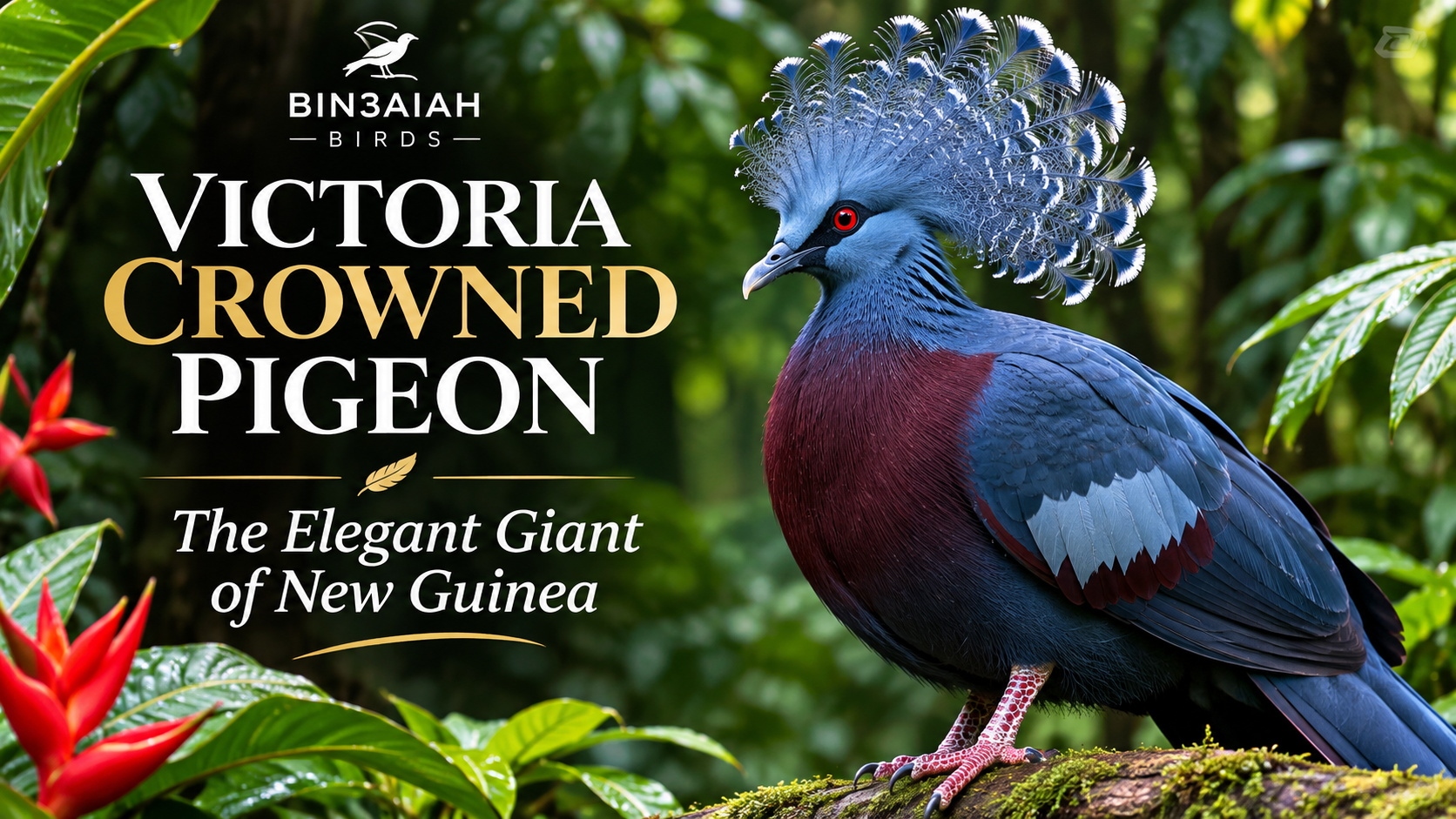
Its most distinctive feature is an elaborate fan-shaped crest composed of delicate blue feathers with pale, white-edged tips. Combined with its rich plumage and confident posture, the crest gives this bird an unmistakably regal appearance.
- Intricate blue and white feathered crest.
- Bright red eyes surrounded by dark facial feathers.
- Blue-grey body plumage.
- Deep maroon or burgundy breast.
- Broad wings with contrasting pale markings.
- Strong legs adapted for walking on the forest floor.

2. Natural Habitat and Geographic Distribution
The Victoria crowned pigeon is native to the northern regions of New Guinea, including parts of Indonesia and Papua New Guinea, as well as several nearby islands.
It primarily inhabits humid tropical environments where dense vegetation, abundant fruit and tall trees provide food, shelter and nesting opportunities.
Preferred habitats
- Tropical lowland rainforests.
- Swamp forests.
- Forested river environments.
- Seasonally flooded forests.
Although capable of flight, the species spends much of its day searching for food among fallen leaves and vegetation.

3. The World’s Largest Living Pigeon
The Victoria crowned pigeon is recognized as the largest living species of wild pigeon. Large individuals may weigh up to 3.5 kilograms, making them considerably heavier than ordinary urban pigeons.
Despite its size, it remains an agile bird capable of flying into trees when threatened and reaching elevated branches for resting and nesting.
Did You Know?
Crowned pigeons belong to the same bird family as the extinct dodo of Mauritius. Their shared evolutionary ancestry illustrates the remarkable diversity of pigeons and doves.
4. Diet and Feeding Habits
Victoria crowned pigeons are primarily fruit-eating birds. They walk through the forest searching for ripe fruit that has fallen from surrounding trees.
Their natural diet includes:
- Fallen tropical fruits.
- Figs and berries.
- Seeds.
- Occasional insects and small invertebrates.
By consuming fruit and transporting seeds, these birds can contribute to natural seed dispersal and forest regeneration.
5. Behavior and Communication
Victoria crowned pigeons are predominantly terrestrial during daylight hours. They frequently move through the forest in pairs or small groups, searching for food.
Their vocalizations include deep, resonant booming sounds. When alarmed, they may take flight with powerful and noticeably loud wingbeats.
Typical behaviors
- Walking slowly while searching for food.
- Maintaining social contact through low calls.
- Flying into trees to escape potential danger.
- Resting and roosting above ground.
- Performing elaborate courtship displays.

6. Courtship, Breeding and Reproduction
During courtship, males perform displays involving bowing, head movements, tail movements and vocalizations to attract a potential partner.
The pair typically constructs a platform nest from twigs and other plant material in a tree. The female usually lays a single egg, and both parents participate in incubation and caring for the chick.
Like other pigeons, Victoria crowned pigeons produce a nutritious substance called crop milk, which provides essential nourishment to newly hatched chicks.
The production of only one egg per nesting attempt makes successful reproduction particularly important for maintaining wild populations.
7. Ecological Importance
The Victoria crowned pigeon is part of the interconnected ecosystem of New Guinea’s tropical forests. Its fruit-based diet allows it to participate in the movement of seeds through the environment.
Protecting this species also helps preserve the habitats shared by numerous other birds, mammals, insects and plants found in the region.
8. Conservation Status and Threats
IUCN Status: Near Threatened
The Victoria crowned pigeon faces increasing pressure from human activities. Protecting remaining lowland forests and reducing unsustainable hunting are important conservation priorities.
Major threats
- Deforestation and commercial logging.
- Conversion of forests into agricultural land.
- Hunting for meat and feathers.
- Capture for the bird trade.
- Habitat fragmentation.
Conservation priorities
- Preserving tropical rainforest habitats.
- Supporting sustainable forestry.
- Reducing illegal wildlife trade.
- Supporting local conservation initiatives.
- Monitoring wild populations and breeding success.
9. Victoria Crowned Pigeon Photo Gallery


Explore more Victoria crowned pigeon photographs
10. Interesting Facts About Victoria Crowned Pigeons
- It is the largest living species of pigeon.
- It was named after Queen Victoria.
- Its crown consists of delicate, white-tipped feathers.
- It belongs to the same family as the extinct dodo.
- It spends much of its time on the forest floor.
- Both parents help raise their young.
- It communicates using distinctive low-frequency calls.
- It usually lays only one egg per clutch.
- It can contribute to tropical forest seed dispersal.
- Its survival depends heavily on protecting New Guinea’s forests.
Frequently Asked Questions
Is the Victoria crowned pigeon the largest pigeon in the world?
Yes. It is recognized as the largest living species of wild pigeon.
Can Victoria crowned pigeons fly?
Yes. Although they spend much of their time on the ground, they can fly into trees to rest, nest or escape danger.
Where are Victoria crowned pigeons found?
They are native to northern New Guinea and several surrounding islands.
What do Victoria crowned pigeons eat?
They mainly consume fallen fruits, berries and seeds, supplemented by occasional insects.
Are Victoria crowned pigeons endangered?
They are classified as Near Threatened by the IUCN, with habitat destruction and hunting among their principal threats.
Why do they have a crown?
The crest is a distinctive ornamental feature that may play a role in visual communication and social displays.
Conclusion
The Victoria crowned pigeon is a magnificent example of the diversity and beauty of the natural world. From its intricate feathered crown to its impressive size and fascinating forest lifestyle, this extraordinary bird stands apart from other members of the pigeon family.
Preserving the tropical forests of New Guinea is essential to ensuring that future generations can continue to admire this remarkable species.